


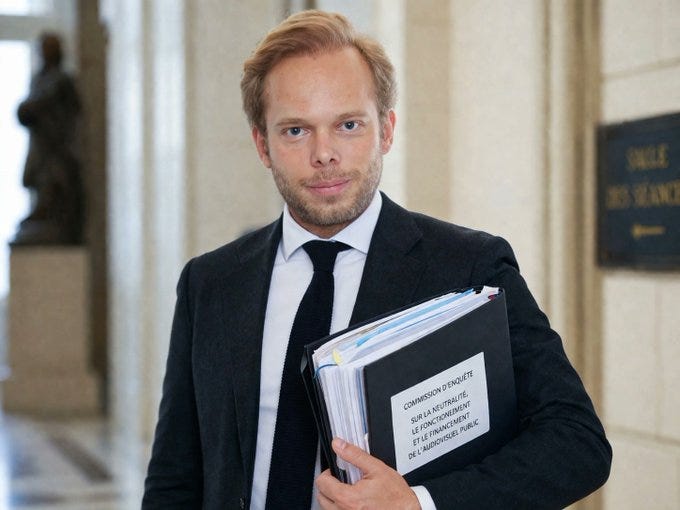
The commission was created on 28 October 2025 by the UDR, an ally of the Rassemblement National, as part of its annual right of allocation. The rapporteur, Charles Alloncle, is from the UDR. The chair, Jérémie Patrier-Leitus, is a Horizons (centrist) MP from Calvados. The two men agree on almost nothing. The latter published, as an introduction to Volume 1, twenty pages of carefully worded but firm distancing from the rapporteur’s approach, whom he accuses of seeking to “prepare minds for the privatisation of public broadcasting.”
67 hearings, 234 sworn witnesses, 150 hours of proceedings broadcast live, and a 551-page report submitted on 27 April 2026 so that what we already knew might finally be written down.
The report establishes facts that sketch the portrait of a media apparatus funded by everyone, meant to represent everyone, but whose actual functioning has been captured to serve a structured political discourse, shaped over time by now-identified networks.
I. Governance under influence: the making of leadership
The first layer is institutional.
In January 2013, François Hollande, President of the Republic (Socialist Party, left), appointed one of his supporters, Olivier Schrameck, to head the CSA, despite his lack of objective expertise in the field. The CSA was then the public regulator of the media in France (now replaced by Arcom). According to Mediapart, the appointment was reportedly supported by David Kessler, a culture adviser at the Élysée and a senior civil servant close to Socialist circles. The same day, Claude Bartolone, then President of the National Assembly (and a central figure of the Socialist Party), appointed Sylvie Pierre-Brossolette to the CSA, described as close to Schrameck.
In 2014, Delphine Ernotte’s sister joined Anne Hidalgo’s municipal team, Mayor of Paris (Socialist Party, left). At the same time, Robert Zarader, a communications strategist close to François Hollande, supported Ernotte’s candidacy while she was a senior executive at Orange, a private telecoms group. At the end of 2014, David Kessler left the Élysée and joined Orange, where he actively supported this candidacy.
In April 2015, during the selection process, Olivier Schrameck unilaterally changed the pre-selection rules within the CSA. Despite internal concerns, the procedure continued. On 21–22 April 2015, Delphine Ernotte was appointed President of France Télévisions, the main French public broadcasting group (comparable to a BBC-type public service broadcaster).
She then appointed Stéphane Sitbon-Gomez as chief of staff, coming from political activism (green-left and socialist circles), who would gradually become one of the group’s key editorial decision-makers, eventually overseeing in 2026 a large part of the strategy and journalists of public broadcasting, without prior journalistic experience. Schrameck acknowledges having spoken with François Hollande before the decision, with the latter expressing reservations about other candidates, while denying any pressure.
Presented as independent, the authority thus appears aligned, through its rules, appointments, and decisions, with the Socialist executive of the time. This weakens its real independence and reveals a systemic functioning that remains active.
II. The double standard in ethics
The second layer concerns the rules as applied.
The case of Patrick Cohen and Thomas Legrand is central: filmed in September 2025 with Socialist Party officials, they discuss municipal elections and Rachida Dati’s candidacy, stating “we do what it takes for Dati, Patrick and me.” No sanctions. No remorse.
By contrast, Jean-François Achilli was removed in 2024 over a mere rumour of a lunch with Jordan Bardella. Institutional justifications invoke context or silence from one of the parties involved. But the report notes an asymmetry: sanctions do not depend on facts, but on the political sensitivity of those involved. The result is a two-tier system, where ethics become variable depending on the camp.
III. Open activism on air
The third layer concerns editorial content.
While top management was co-opted, on-air content itself became openly activist, without consequences.
The case of Diane Saint-Réquier, contributor to France TV Slash between 2018 and 2022, is striking. On her Twitter account linked to her work for the public service platform, funded by taxpayers and explicitly aimed at minors, she posted:
“catapult cops to launch them at riot police during protests”
“dead men don’t rape”
“every day I want to kill men”
Her Twitter bio displayed the acronym ACAB (“All Cops Are Bastards”) since 19 September 2019.
Another example is Merwane Benlazar, a columnist on France Inter, following a similar logic. He wrote to a woman on X :
“You were still in clubs while a woman’s place is at home with her father. Fear your Lord.”
“Great, I prefer to burn her.”
France TV Slash itself reportedly claims internally that it no longer represents France “as it is, but as we would like it to be.” The report sees here a shift: from public service broadcasting to an instrument of ideological transformation.
IV. The ecosystem of ideological validation
The fourth layer is more diffuse but structural.
The report documents the editorial choice of entrusting France Culture’s press review to Nora Hamadi, whose far-left political engagements are public.
It also highlights the fact-checking unit, presented as a guarantor of factual verification, but whose editorial choices reveal partisan alignment.
Reporters Without Borders (RSF), an international organisation presenting itself as non-partisan and widely used as a moral reference, is also scrutinised. While its charter claims neutrality, its petitions tell a different story. RSF is nevertheless used by public broadcasters and aligned media as a guarantee of neutrality. The report concludes that this guarantee does not hold.
The issue is not incidental. The system operates through successive layers of validation: journalist verification, editorial arbitration, ethics committees, regulatory oversight, international NGO legitimacy. Each layer is biased in the same direction. It is an apparatus. And an apparatus cannot be reformed from within, because its agents are precisely those who built it.
V. France Médias Monde and strategic inversion
The fifth layer is less frequently discussed.
France Médias Monde, which includes France 24, RFI, and Monte Carlo Doualiya, has an annual budget of nearly €300 million to project France’s voice globally.
The report documents several cases of broadcasts on these channels containing rhetoric hostile to France itself. Ambassador Sylvie-Agnès Bermann, quoted in hearings, asked in striking terms: “How do you expect us to fight anti-French discourse when your own channels broadcast it?”
She named Alain Foka and Claudy Siar, journalist and host of the programme Couleurs tropicales on RFI, who notably compared Rima Hassan to Nelson Mandela and accused “French journalism” of “collaboration” with what he called “21st-century fascism.”
French public broadcasting, through a form of ethnomasochism, accepts this inversion. Yet the report recalls the stakes: in a context of information warfare where influence media invest heavily, particularly in Francophone Africa, the editorial weakening of one of France’s only instruments is a strategic failure. External public broadcasting is not a neutral space. It is a weapon that is being turned against its owner.
VI. The outsourcing economy
The sixth layer is perhaps the most structurally important for understanding the system.
France Télévisions outsources a massive share of its programming to private producers. The result is an oligopoly. Three groups, Mediawan, Banijay, Together Media, capture most contracts. Tacit renewals have replaced calls for tender. Margins are opaque. So are the remuneration schemes of presenter-producers.
The “presenter-producer” system is itself a glaring anomaly: a television host simultaneously runs the company producing the very show they present. In the same week, they are a public service employee, the head of a private company billing the public broadcaster, and a public-facing figure presented as independent on air. Conflicts of interest are no longer to be prevented; they are embedded in the structure.
The report documents movement of executives between public broadcasting leadership and private production companies, noting a “normalisation of conflict-of-interest situations.”
And what are the ethics committees doing?
The ethics committee of France Télévisions has issued nine opinions since its creation in 2017, nine in eight years for France’s largest public broadcaster. Its annual report sometimes fits on a single sheet of paper.
VII. The upstream factory: schools and elite reproduction
The seventh layer may be the most structural of all, because it operates upstream of the system.
The report documents a chronic lack of pluralism among guest lecturers in journalism schools. These schools train those who will later shape newsrooms, and ultimately public opinion.
If lecturers overwhelmingly come from the same editorial camp, and if the professional norms they transmit systematically exclude certain perspectives, the result will not be visible in any single newsroom at any given moment. It will appear, over a generation, in the homogeneity of the entire media landscape.
Cohen, Legrand, Saint-Réquier, Benlazar are not accidents: they are products of a “woke” training system that selects and shapes convergent profiles. Gramscian metapolitics says nothing else: the battle for institutions is won in schools, long before it reaches newsrooms. The left understood this very well.
What remains
The Alloncle report has inscribed into parliamentary procedure what had until now been dismissed as right-wing grievance. These 234 sworn testimonies, 150 hours of public hearings, and 551 pages published after parliamentary debate will not disappear. They will remain, as a historical object, as a marker, as a reference point from which any future discussion on public broadcasting must begin.
We pay, through our taxes, without explicit consent, approximately €4.2 per month per citizen for a public service which, in its current configuration, functions as a system that acts against us and does not represent us.
The argument is now documented. What is done with it is a political decision.
But after reading the Alloncle report, no one should come and claim that there is no left-leaning ecosystem promoting hatred and falsehoods against its own people.
Voxeuropa Herald is an initiative that shares the voices shaping Europe today: elected officials, essayists, philosophers, activists, artists and influencers. These portraits are collective responses to the crises shaking our Europe. Faced with the major upheavals of our times, Voxeuropa Herald gives a voice to those who, throughout Europe, share solutions and visions for the future. The message is clear : European realities call for European responses.
🔹 Follow Voxeuropa on : X | Instagram | Telegram |
🔹 To support us - Paypal
🔹 Share, comment, and debate — ideas gain power when they circulate.