



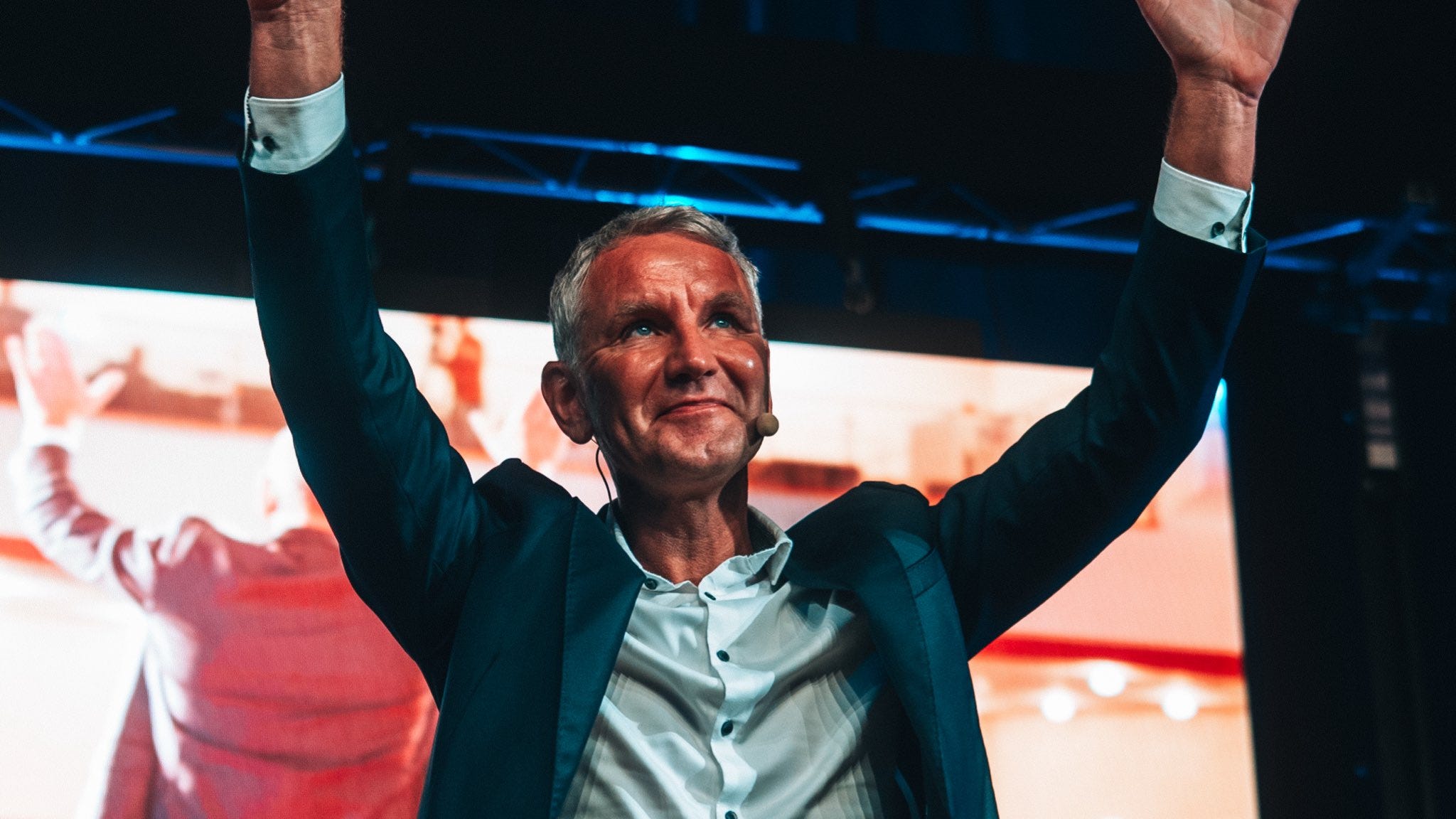
On April 28, 2026, one of the most closely watched politicians in Europe spoke for four and a half hours, without interruption, on the ungeskriptet channel run by German podcaster Ben Berndt. Seventy thousand people liked the video overnight. Der Spiegel and Berliner Zeitung immediately called it a scandal. The unspeakable had been allowed to present himself as a human being. The mainstream press followed with the same outrage.
The format itself matters. In Germany, Björn Höcke is what Berndt calls, without irony, the Voldemort of politics. The man whose name is not spoken. He has been convicted for using a slogan, kept off TV panels, and even blocked by parliamentary decision from presiding over the opening session of the Thuringian parliament, although he leads its largest group. No one had ever let him speak for this long.
That alone is enough to make the moment worth paying attention to.
But there is something else. Beyond the controversy, this kind of format allows something rare. A politician taking the time to lay out the intellectual foundations of what he believes. If you want to understand where parts of the German right stand today, or more broadly where European politics might be heading, this is not something you usually get to see.
Höcke remains, in any case, the untouchable man of an untouchable party. Maybe that is precisely why it is worth looking a little more closely. Voxeuropa offers here a portrait of Europe’s most controversial political figure.
The man whose name is not spoken
A bit of context is necessary.
Björn Höcke, born in 1972 in Rhineland, has led since 2014 the Thuringian branch of the AfD (Alternative für Deutschland), a party founded in 2013 in opposition to Angela Merkel’s European policy. Since then, it has become one of the main political forces on the German right.
Thuringia, in the former East Germany, marked a turning point in September 2024. For the first time, the AfD came first in a regional election, with 32.8 percent of the vote. Höcke now leads the largest parliamentary group in that regional assembly.
And yet, he has never held executive power.
The reason is the Brandmauer, the “firewall.” A strict rule followed by other parties: no cooperation with the AfD, at any level, on any issue. It comes from Germany’s historical memory, and over time it has become something close to doctrine. The AfD will not govern. And Höcke, even less so than the others.
There is also the legal aspect.
Höcke was convicted twice, in 2024 and again on appeal, for using the slogan Alles für Deutschland (“Everything for Germany”). German courts ruled that the phrase had been used by the SA in the 1930s and that, as a trained history teacher, he could not have been unaware of it. He insists he acted in good faith, pointing out that the same words appear on war memorials that predate Nazism.
During the interview, he comes back to this point repeatedly, almost like a fixed reference:
“I have a criminal record for a thought crime that does not exist in any other country in the world.”
No Western country has a direct equivalent. Legally, the discussion is still open. Politically, it is not. He has a record, and it is used.
There is more.
Germany’s domestic intelligence service, the Bundesamt für Verfassungsschutz, has classified the AfD’s Thuringian branch as “proven right-wing extremist.” Höcke lives under permanent police protection. When he arrives for the interview, several security teams are with him.
Ben Berndt jokes:
“It doesn’t smell of sulfur yet, even though I’ve already been in this room for a few minutes.”
That is the strange effect surrounding him. A kind of constructed aura. Something close to a spell.
The teacher from Hesse
If you look past the media image, the background is much more ordinary than you might expect.
Höcke comes from a family of refugees from East Prussia. He grew up in Westphalia, studied history and sports, and became a teacher. In 2008, he started working in a secondary school in Hesse known for being difficult, with a high proportion of students from immigrant backgrounds.
At the same time, his private life settles into something stable. He is married, has four children, and moves to Thuringia, where he lives in a 500-year-old listed farmhouse. When he talks about those years, he describes a fairly typical middle-class life.
The turning point, according to him, happens at school.
He teaches German to children who do not speak it. He simplifies materials so they can follow. He watches tensions between groups, especially between Turkish and Kurdish students, play out again and again in the schoolyard.
At some point, it becomes too much.
“I can’t take it anymore. I have to change schools.”
Politics comes later, and not all at once. He joins the CDU’s youth organization, the Junge Union, then leaves. He is briefly drawn to Helmut Kohl and his idea of a “moral and spiritual turn” in the 1980s, then disappointed. And finally, in 2013, the AfD appears in the context of the euro crisis.
At the beginning, identity is not even the main issue for him.
“This country is blocked. This people has lost itself.”
He also talks about his children, about the fact that they were bullied at school because of who he is, about the nights spent trying to comfort them. And about what they tell him now:
“Dad, it hasn’t always been easy, but we’re proud of what you do.”
Then he shifts to something else. Demonstrations against him.
“The pure hatred on those faces. If they could get hold of me, they would tear me apart.”
The society of trust
The central idea in the interview revolves around a single concept: the Vertrauensgesellschaft, a society based on trust.
Höcke refers to Ernst-Wolfgang Böckenförde and his well-known theorem: the liberal state depends on conditions it cannot create itself.
The point is not particularly ideological at first. A functioning society depends on things like trust between people, shared norms, a common language, a sense of the collective. None of these can simply be produced by institutions.
From there, he draws his conclusion.
A society of trust takes time. Centuries, even. It develops through trial and error. What works is kept, what fails is abandoned. But all of that requires something basic: a population living together long enough to adjust to one another.
This is where his rejection of multiculturalism comes in. He makes the point in a slightly unexpected way, quoting Daniel Cohn-Bendit:
“Multicultural societies are fast, harsh, cruel, and lacking in solidarity.”
Then comes the broader diagnosis:
“Thirty years ago, as Germans, we did not have to worry when entering public space. Today, we do. Thirty years ago, schools worked. Today, we write incident reports. The cultural foundation is collapsing, and with it the foundation of freedom.”
For him, security is not mainly about policing. It is a consequence of shared trust. When that disappears, force cannot replace it.
This is the basis of his migration policy. A halt to non-European immigration. The removal of social benefits for people without legal status, reduced to what he describes as “bed, bread, soap.” And something he calls remigration.
He breaks that down into three groups. Those without legal status, who should be deported. Those who are culturally integrated, who stay. And a third group, the largest, where change would happen gradually, by reducing the country’s attractiveness rather than through mass expulsions.
The distinction matters. It does not make the policy less radical, but it does make it harder to simplify.
An inverted politics of memory
Another key part of his thinking has to do with memory.
Postwar Germany built much of its political identity around what is called Erinnerungskultur, a culture of memory centered on responsibility for Nazism and a continuous effort to confront that past. For a long time, this was broadly accepted. Today, it is increasingly questioned, not only by Höcke but also by some historians who worry that it has become too rigid to deal with the present.
Höcke uses a more technical German term, einseitige Vergangenheitsbewirtschaftung, which could be translated as a one-sided management or exploitation of the past. What he means is that guilt has become a political instrument.
He formulates it in a very direct way:
“When a people loses identification with its own history, it loses its capacity to exist as a state.”
And also:
“You cannot build a society of free citizens on a negative collective consciousness.”
He does not deny what he calls the Schattenseiten, the dark sides of history. He mentions them several times when speaking about Nazism. But he refuses the idea that they should be the only framework through which history is understood.
The most sensitive moment in this part of the interview concerns Dresden. The Allied bombing of February 1945, which killed tens of thousands of civilians.
Höcke has, in the past, taken part in commemorations organized by identitarian groups. He addresses this openly. He says he does not regret having been there, but adds that today he would choose a more “dignified” form, mentioning the Heidefriedhof cemetery, where he went two years earlier.
He describes a small monument representing a young girl, a symbol of the children killed, which was recently vandalized.
From this, he draws a broader conclusion:
“We need to keep alive what war is. And after the terrible wars of the twentieth century, we have had enough of war in all its forms.”
For him, German politics should be oriented toward reconciliation, toward understanding between peoples, and toward preserving peace.
The lesson of Westphalia
Höcke also openly presents himself as an admirer of Otto von Bismarck.
“I admire and venerate his legacy.”
This matters because Bismarck represents, in German political thought, a very specific approach. A realist approach, where foreign policy is about interests rather than moral missions.
Höcke develops this idea further by going back to the Peace of Westphalia in 1648, which he describes as a kind of starting point for the European system.
The logic, as he explains it, is simple. War is part of human reality. But it should be contained. It should be declared formally, fought between states, and ended with a formal peace whose goal is to make former enemies into partners again.
This way of thinking is close to that of Carl Schmitt, even if Höcke does not explicitly cite him.
“Today, we call it the war on terror or peacekeeping missions. But it is still war. Just presented differently.”
He applies this framework to the war in Ukraine. He is clearly opposed to German involvement, to arms deliveries, and to the idea of moving toward a war economy.
He even imagines a scenario in which Chancellor Friedrich Merz and Defense Minister Boris Pistorius would call for mobilization.
His answer is blunt:
“Many Germans would say: to be shot for this country, for this multicolored society? No, thank you.”
Post-parliamentarianism
Another important part of his argument concerns institutions.
Höcke uses the term Postparlamentarismus, post-parliamentarianism. What he is describing is a situation where formal democratic structures still exist, but their functioning has changed in practice.
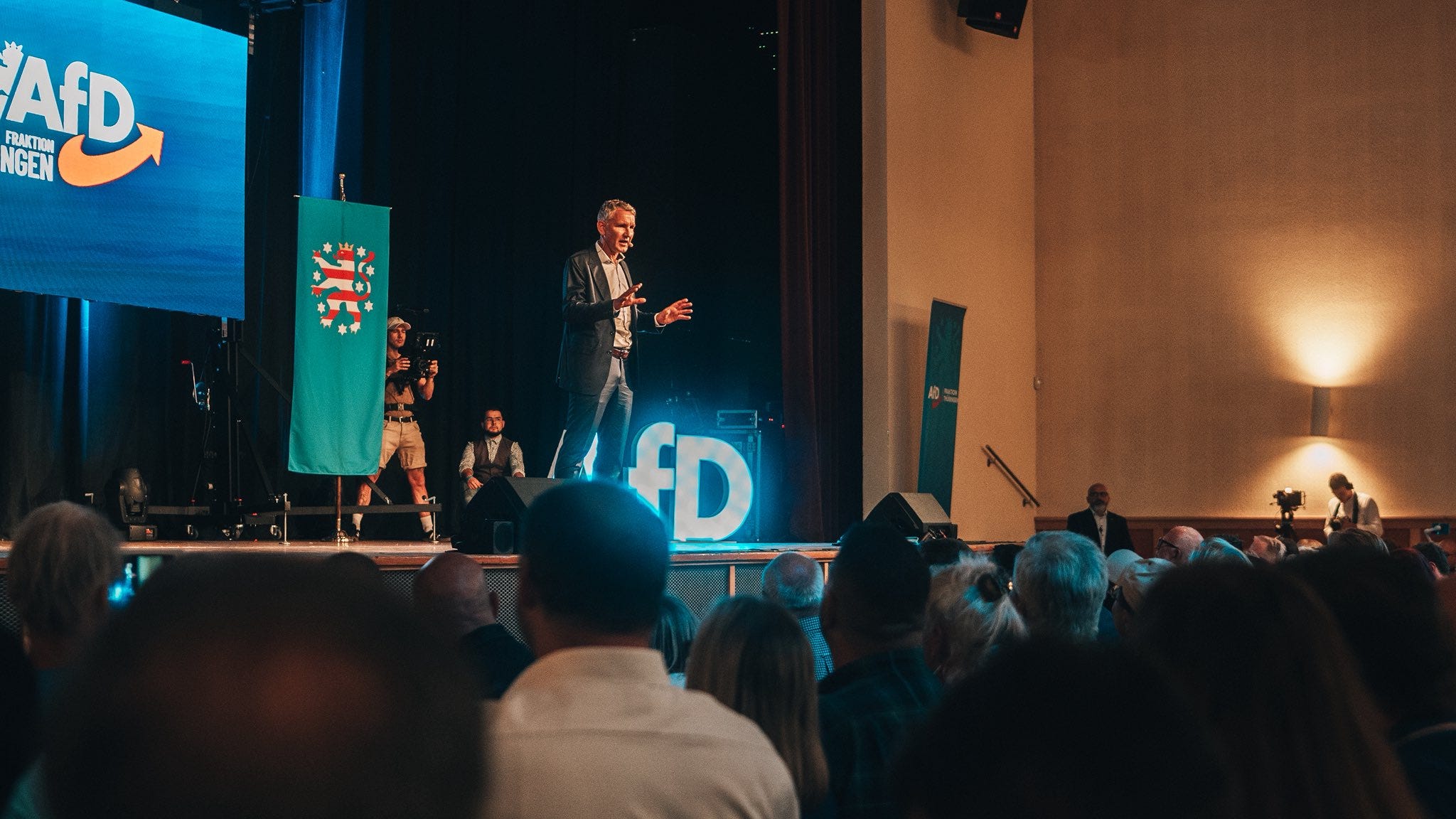
In Thuringia, his party has the largest number of seats, but because of the Brandmauer, it is systematically excluded from power. Even positions that would normally go to the largest group, like the presidency of the parliament, have been denied to AfD candidates through coordinated voting by other parties.
For him, this is not a technical detail. It is a break with a fundamental democratic rule.
He extends this critique to the Verfassungsschutz, which he accuses of shifting from protecting the constitution to monitoring political opposition.
And more broadly, he lists what he sees as signs of an authoritarian drift: laws regulating online speech, such as the Netzwerkdurchsetzungsgesetz or the European Digital Services Act; police searches linked to opinions expressed online; attempts to ban publications like Compact; calls for boycotts; what he sees as a politicized judiciary; and cases where individuals are prosecuted or excluded from the financial system, including figures like Martin Sellner.
“When I see all this, I am afraid.”
The homeland as a debt to one’s children
The final part of the interview returns to something more personal, but also more fundamental.
Höcke describes the homeland as something that is passed on. Something you receive, and something you owe.
“I want Germany to live. I want Germany to remain the homeland of my children, not just in name, but in substance.”
He goes further:
“If we become a minority in our own country, if we lose ourselves to the point where we can no longer pass on our culture, then this country will have no future.”
What he sees for Germany, he says, he also sees for Western Europe as a whole. He uses a strong word: Zivilisationsbruch. A civilizational rupture.
The term has its own history. It was used by Dan Diner to describe Auschwitz as a break in civilization. Höcke turns it around. For him, the rupture is not in the past. It is ahead.
In doing so, he places himself within a broader intellectual tradition, referring implicitly or explicitly to figures such as Maurice Barrès, Dominique Venner, and Roger Scruton.
The homeland, in this perspective, is not an ideology. It is a condition of existence.
Why this matters beyond Germany
At this point, a natural question arises. Why should any of this matter outside Germany?
One answer is legal. Björn Höcke is, today, one of the few European politicians to have been criminally convicted for the use of a slogan. Whatever one thinks of his positions, that precedent raises broader questions. Laws evolve. What is exceptional in one country can become less so over time.
Another answer is intellectual. The themes he raises are not specific to Germany. The erosion of trust, the role of memory, the transformation of war into moral confrontation, the closing of political systems, the idea of the nation as something inherited. These are debates that exist across Europe.
And then there is the media aspect.
Seventy thousand likes overnight. Tens of thousands of comments, many of them supportive. A level of attention that, in this case, surpassed even official interviews with the German chancellor.
Something is shifting. Not just politically, but in how political discourse circulates.
What is happening around Höcke is not only about Höcke.
For anyone who has followed the situation in their own country, some of these patterns may feel familiar. Institutions that monitor opposition more closely than governments. Expanding legal frameworks around speech. Political isolation strategies that grow as movements themselves grow.
None of this is uniquely German.
Reading Höcke today is not only about Germany. It may also be, in part, about what lies ahead elsewhere.
Photo : Filmkunstkollektiv
Voxeuropa Herald is an initiative that shares the voices shaping Europe today: elected officials, essayists, philosophers, activists, artists and influencers. These portraits are collective responses to the crises shaking our Europe. Faced with the major upheavals of our times, Voxeuropa Herald gives a voice to those who, throughout Europe, share solutions and visions for the future. The message is clear : European realities call for European responses.
🔹 Follow Voxeuropa on : X | Instagram | Telegram |
🔹 To support us - Paypal
🔹 Share, comment, and debate — ideas gain power when they circulate.
Thank you for this insightful piece. It is very hard to get good information on whats happening in german speaking spheres from the outside.
Brilliant piece of writing. Thank you.