


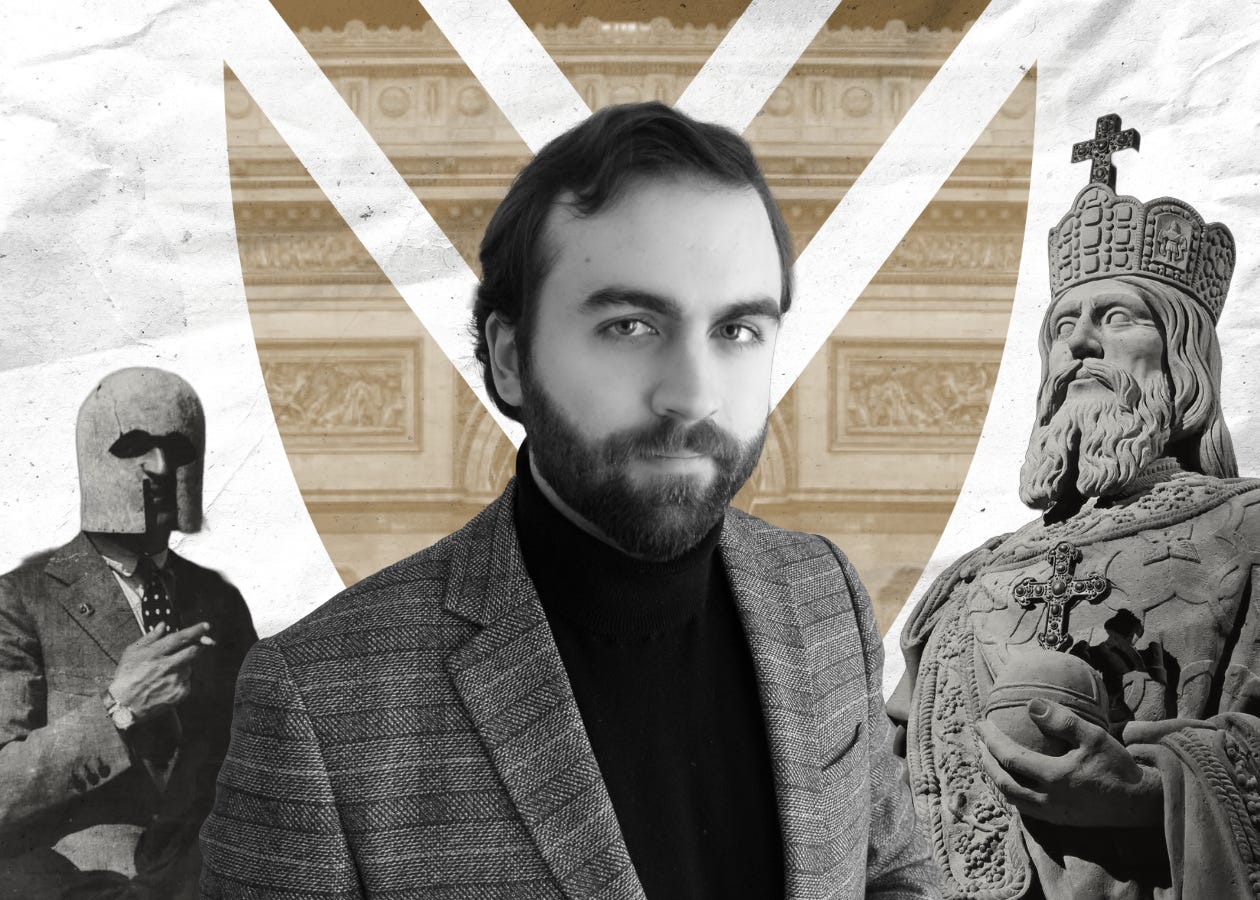
Antoine Dresse is a Belgian philosopher and YouTuber. On his channel Ego non, he produces videos about various European thinkers such as Oswald Spengler, Gustave Le Bon, Edmund Burke, and Carl Schmitt. He also collaborates with Romain Petitjean as editorial director at the Iliade Institute, as well as with his fellow countryman David Engels. He is the author of À la rencontre d’un cœur rebelle : Entretiens sur Dominique Venner (co-written with Clotilde Venner) and Le réalisme politique: principes et présupposés.
Could you introduce yourself and tell us about your work?
I’m originally from Liège, in French-speaking Belgium. I studied philosophy in Brussels and later in Fribourg, Switzerland. Today, I mainly work as a video creator through my YouTube channel Ego Non, where I produce videos on political philosophy. I have also been collaborating with the Iliade Institute for the past two years. In addition to the editorial work I do within the Institute, I will soon be co-hosting one of its training sessions in Belgium, together with Jeremy Baneton. I also write regularly for Éléments, and I recently published an essay on “political realism.”
What are the main goals you seek to achieve through your work?
The aim of my channel Ego Non is to contribute to the rebuilding of a coherent worldview—one structured around philosophical principles capable of defending European civilization. Criticizing the excesses and aberrations of progressive and egalitarian thought is necessary, but we cannot limit ourselves to merely commenting on the whirlwind of current events. We must be able to connect concrete political struggle to underlying principles, to a worldview, and to well-developed theoretical foundations—not as a means of escapism, but in order to assert a positive force. As Bergson famously said, one must strive to “act like a man of thought and think like a man of action.”
In each of my videos, I therefore try to present a key concept or major idea from a particular thinker, always seeking to connect it, in one way or another, to a contemporary political issue so as to offer a new angle of reflection.
As a Belgian, you are at one of the crossroads of European culture. What lesson do you draw from that ?
First and foremost, a lesson in European identity. Born in the province of Liège, I grew up near the Dutch and German borders, and it was not uncommon for me to take little trips to Maastricht or Aachen. Being at the crossroads of four major European cultures—Dutch, German, French, and English—allows one to better understand what we share. In a way, I have always felt “European”: European because I am Belgian, and Belgian because I am European.
Who are your intellectual and literary inspirations? Are there authors or thinkers, particularly German ones, who have especially influenced your work?
Without a doubt! Germanic culture has been very important to me since my adolescence, starting with my discovery of Wagner, which, without exaggeration, was one of the most profound shocks of my life. From there, I became interested in Schopenhauer and Nietzsche, then in the great names of German literature of that era: Goethe, Schiller, Herder, Hölderlin, Kleist, Eichendorff, and so on. Having studied philosophy, Germany again offers indispensable figures such as Kant, Fichte, Hegel, Marx, Husserl, and Heidegger. I must also mention the so-called “Conservative Revolution,” as defined by Armin Mohler, whose representatives—Ernst Jünger, Arthur Moeller van den Bruck, Oswald Spengler, and especially Carl Schmitt, though he is somewhat atypical in this current—played a decisive role in shaping my intellectual formation.
However, my inspirations are not limited to the Germanic world. I have long been passionate about Russian literature and original thinkers like Tchaadaïev, Danilevski, Konstantin Leontiev, Vladimir Soloviev, Berdiaev, and Solzhenitsyn. Counter-revolutionary thinkers have also provided a solid foundation for reflection. But I would especially like to mention authors who are difficult to classify, yet with whom I increasingly identify, such as Machiavelli, Gustave Le Bon, Vilfredo Pareto, Isaiah Berlin, or Julien Freund.
How has your experience as a philosopher influenced your intellectual approach?
I believe my approach stems entirely from my interest in philosophy. To those judges who offered him freedom on the condition that he abandon philosophy, Socrates replied, “The unexamined life is not worth living.” This principle reflects my own mindset. Practicing philosophy primarily involves clarifying one’s thoughts and freeing oneself from unexamined “opinion,” and this is what led me to the thinkers I present on my channel.
What does it mean to be “European” in the contemporary context ?
The very need to ask this question shows how much general knowledge and historical awareness among Europeans have eroded. Since Charlemagne—nicknamed in his lifetime “Rex Pater Europae”—Europeans have rarely doubted that they were part of a single civilizational space. National consciousness emerged only late, within a pre-existing European society. Today, many feel solidarity with the rest of the world before Europe, or, conversely, display a narrow, caricatural, anti-traditional chauvinism. We therefore suffer from both an uprooted cosmopolitan education and an excessively nationalist rewriting of history from the last century.
Being European today means rejecting both the cosmopolitan, egalitarian ideology that treats individuals as interchangeable, and also reconnecting with deep historical roots, naturally drawing from the same sources as other European peoples. But it is more than that: being European also means recognizing a shared past and understanding that we face a shared challenge. The collapse of our culture, anthropological decline, and demographic replacement are threats that affect Europe as a whole.
How should we defend and promote European heritage?
Politically, at the level of states, this involves defining oneself first and foremost as part of a specific civilizational whole, which means rejecting anything that undermines this space.
On a personal level, it means refusing the mediocrity promoted by mass subculture. European culture has beautifully combined refinement and grandeur, sophistication and strength; we must cultivate both in our inner lives: demonstrating strength by resisting anthropological decline and the erosion of courage, as Solzhenitsyn once warned, and nurturing an appreciation for the arts that elevate the spirit. To elevate the spirit, one must sometimes detach from the political news cycle.
Finally, defending European heritage ultimately means transmitting it. Culture exists only through the people who carry it; the preservation of any culture depends first and foremost on the continuity of the founding population. As long as there are Europeans, European culture can experience transformations and renaissances.
A term popular on the right is “remigration.” How do you understand it?
The term “remigration” is indeed increasingly present in right-wing debates. For some, it is a mirage; for others, a necessity. So far, however, few concrete proposals have been made. To my knowledge, Martin Sellner, a key figure in the Austrian identitarian movement, is one of the few who has seriously considered how the remigration of culturally, economically, politically, and religiously unassimilable foreigners could succeed. Earlier this year, he published a small but very interesting book with Antaios (Remigration, ein Vorschlag) that has the merit of addressing this question seriously, avoiding the various fantasies that the concept often provokes. This is a path we must also pursue in the French-speaking world. After popularizing the idea of remigration online, we must now approach it with calm and reflection.
As Sellner shows, a remigration policy would essentially consist of incentives for voluntary departures, reforms to nationality law, or expulsions based on clearly defined criteria, such as criminal activity. By his own account, it is a process that would span 30 to 40 years.
Beyond demonstrating feasibility, Europeans must also be convinced of its desirability. Many are initially shocked by the notion of remigration, associating it with inhumane and unacceptable scenarios. Yet the opposite is true: as Aristotle noted in antiquity, multi-ethnic societies are inherently conflict-prone. The only humane scenario to prevent escalating violence is therefore a rational remigration policy.
France and Germany are Europe’s two largest nations. For Europe to function properly, they must move in the same direction. How can France and Germany collaborate ?
First, by critically examining their own national histories. Since the time of François I, France has often acted against Europe, for example by calling on non-European peoples to intervene against its neighbors. Germany, by contrast, has tended to envision Europe under German hegemony (as seen in the historical reinterpretation of the Holy Roman Empire as a proto-German state, when it was originally a European empire).
The French and Germans must therefore perform a historical reversal and recognize that these contradictory tendencies gradually led to Europe’s decline. While rewriting the past is pointless, I see the division of the Frankish Empire in 843—and the separation of the “West Franks” and “East Franks”—as Europe’s original catastrophe. As Austrian historian Jordis von Lohausen noted: “The European core space was henceforth divided into an Atlantic part and another facing the North Sea. This was Europe’s tragedy.”
Should we build a European “Vorfeld,” a network of structures to strengthen cultural and metapolitical ties ?
I assume you are referring to Benedikt Kaiser’s book Die Partei und ihr Vorfeld. He is entirely right to encourage his compatriots to create a right-wing “mosaic” that, despite comprising diverse tendencies, would push in the same direction and support each other, just as left-wing groups do. This “Vorfeld” must exist not only nationally but also as a trans-European network. Intellectuals and identitarian figures, at least, have a duty to look beyond their national reality and understand broader trends across Europe.
At its level, the Iliade Institute already seeks to build a European network, through partnerships with other think tanks and publishing houses (Instituto Carlos V, Passagio al Bosco, JungEuropa Verlag, etc.). I also discuss this with friends such as David Engels and Julien Rochedy, and we will certainly work toward this goal in the future.
Voxeuropa Herald is an initiative that shares the voices shaping Europe today: elected officials, essayists, philosophers, activists, artists and influencers. These portraits are collective responses to the crises shaking our Europe. Faced with the major upheavals of our times, Voxeuropa Herald gives a voice to those who, throughout Europe, share solutions and visions for the future. The message is clear : European realities call for European responses.
🔹 Follow Voxeuropa on : X | Instagram | Telegram | TikTok | Paypal
🔹 Share, comment, and debate — ideas gain power when they circulate.