


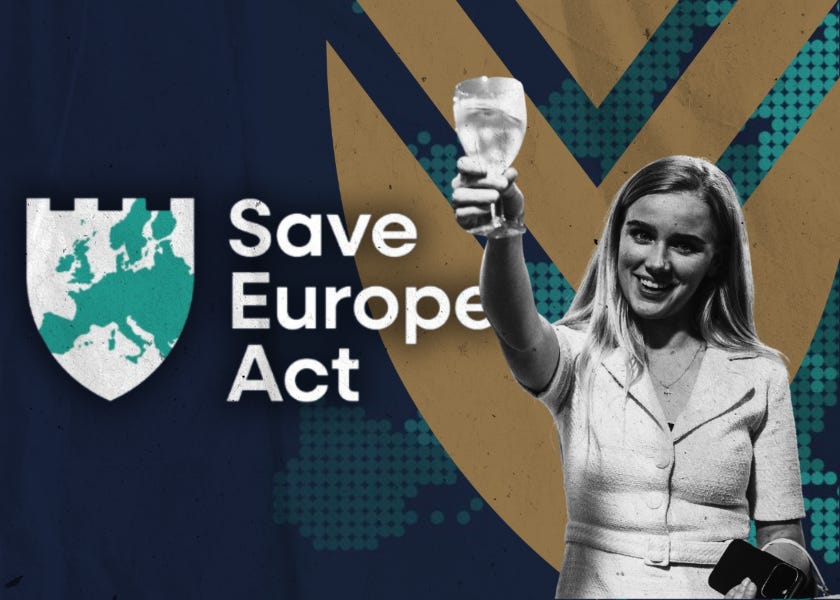
Eva Vlaardingerbroek is no longer simply a dissident voice in the European media landscape: she has become one of the faces of a concrete political offensive. Co-founder of the Save Europe Act alongside Martin Sellner, backed by Viktor Orbán, and banned from British territory since January 2026, the Dutch activist embodies a generation of European patriots who have decided to move from words to action. In this interview with Voxeuropa Herald, she reflects on the two years since her landmark speech at CPAC Budapest, breaks down the legal and political mechanisms behind the European Citizens' Initiative she is driving, and sets out her vision of a Europe that fights back.
At CPAC Budapest in 2024, you declared that the Grand Replacement was no longer a theory but a reality. Two years on, what concrete developments support that assessment, and what has changed since that speech?
When I spoke at CPAC Budapest in 2024, I said the Grand Replacement was no longer theory but reality. It was still very controversial at that time. I knew I was taking a big risk talking about it, but the truth is the truth and had to be said. Especially on a stage like that. Now, two years later, sadly the numbers speak louder than ever. Major European cities have continued their rapid demographic transformation. Native European populations are declining while non-European inflows, legal and illegal, are replacing them. Crime statistics across Sweden, Germany, France, the Netherlands, and the UK show persistent overrepresentation of certain non-European groups in violent and sexual offenses. Parallel societies have expanded, not contracted. Rape gang scandals continue to surface with the same patterns. Welfare systems strain under the weight of populations that arrived as net consumers rather than contributors. Political elites still mouth platitudes about “diversity” while ordinary Europeans watch their neighborhoods, schools, and public spaces change beyond recognition. The trajectory I warned about has only steepened, but the upside is that finally it is being openly discussed. However, the situation is so urgent that I wanted to go beyond the “talking stage.” That is why the Save Europe Act exists: to take tangible action and give people an instrument to force Brussels into taking position.
The Save Europe Act is a European Citizens’ Initiative: if you reach one million signatures across seven member states, the Commission is legally required to respond. You crossed 100,000 in forty-eight hours. How do you envision scaling up to the million-signature threshold, and in which countries is resistance the strongest?
We crossed 100,000 signatures in less than forty-eight hours because the message resonates. People are tired of being gaslit. To reach one million across seven member states, we will use relentless grassroots work: national campaigns tailored to each country’s language and concerns, alliances with patriotic parties and movements already in parliament, viral content as well as physical events. We are already well past the early milestones and climbing fast.
The Commission may choose not to act, even after one million signatures. Have you planned a fallback, or does the mobilization itself carry political value independent of the institutional response?
The Commission may indeed drag its feet or refuse meaningful action even after one million signatures. That is why the mobilization itself carries enormous political value. Every signature is an act of civic defiance. Every share, every conversation, every local group formed around this initiative shifts the Overton window and builds patriotic people power. It forces the issue into the open. It also gives cover and legitimacy to national governments to start remigration politically. Even a formal negative response from Brussels would not be a loss: it would expose a deep anti-democratic sentiment and mobilize even more people. We do not place our ultimate hope in the Commission. We place it in the awakening of the European peoples. If they shut it down, we will go to Brussels and shut their censorship down.
The text calls for a moratorium on non-European immigration, a remigration framework harmonized at the EU level, and the elimination of welfare provisions that function as pull factors. What treaty modifications would be required to make these measures enforceable, and what do you see as the principal legal barrier to be removed?
The concrete measures in the Save Europe Act, a moratorium on non-European immigration, harmonized remigration framework, removal of welfare pull factors, require real changes in how the EU operates. Actually a total overhaul. The principal legal barrier is not any single treaty article but the accumulated superstructure of human rights law, especially the European Convention on Human Rights and the rulings of the Strasbourg Court that are continually used to violate the human rights of the indigenous peoples in Europe. They block the deportation of serious criminals and leave nations defenseless. The EU’s own migration and asylum rules, built on non-refoulement, must be fundamentally rewritten. Treaty modification or, where necessary, sovereign reassertion of the kind we see in Hungary would be required. Article 4(2) TEU already recognizes the right of Member States to protect their national identities; we intend to make that clause mean something again.
The Save Europe Act was launched with Martin Sellner and five other initiators, and receives the backing of Viktor Orbán. How do you bring such different political sensibilities together around a common text without diluting it?
We unite around a non-negotiable core: Europe belongs to the European peoples, our civilization has a right to continuity, and the current replacement must be reversed. Orbán brings the experience of a statesman who has actually governed against the current and protected his nation’s demographic character. Sellner and the network around the Remigration Summit bring activist energy. The text stays sharp because it refuses to dilute the essentials, borders, returns, ending incentives, into vague integration talk. It is the consensus of all European patriots in its purest form and therefore manages to bridge national, cultural, and social differences.
Remigration: who goes back, according to what criterion, by what means, within what legal framework? Can you describe concretely what you are calling for?
Remigration, concretely, begins with those who have no right to be here. All illegal entrants, visa overstayers, and rejected asylum seekers must be removed. All foreign nationals convicted of serious crimes must be deported. We then build a harmonized EU-wide framework for broader remigration: pressuring groups who have formed parallel societies, who reject our values, and whose presence actively undermines social cohesion and safety. Means include diplomatic agreements with countries of origin, voluntary return incentives, and, where necessary, compulsory removal with full legal process. This is not extreme; it is the minimum required to restore lawful order and preserve the possibility of a future European civilization. We start with the obvious cases and expand the framework methodically and legally.
You have built part of your audience around the link between mass immigration and the physical safety of women, an angle that certain feminists refuse to address. Why, in your view, is this silence so persistent, and what does it reveal about the state of contemporary feminism?
The silence of so many feminists on the link between mass non-European immigration and the safety of European women is one of the most revealing failures of this ideology. Contemporary feminism has decided that certain men must be protected from “racist” scrutiny even when the victims are native women and girls. What we have seen in Cologne, Rotherham, Telford, and countless other places are gut-wrenching examples of that reality. Yet the response is often deflection, minimization, or outright censorship, attacking the women who speak out. This reveals that much of modern feminism is no longer primarily about women; it is a vehicle for anti-Western, anti-white ideology that treats European peoples and their safety as a secondary concern. Real concern for women should not shy away from admitting which populations are driving the explosion in sexual offenses.
In January 2026, the British government banned you from entering the United Kingdom, with no right of appeal, on the grounds that your presence was “not conducive to the public good.” What does this decision reveal about the state of civil liberties in Western Europe?
The British government’s decision in January 2026 to ban me from the United Kingdom, with no right of appeal, on the grounds that my presence was “not conducive to the public good,” tells us everything about the state of civil liberties in Western Europe. A Dutch woman without a criminal record can be barred from an entire country for speaking uncomfortable truths about immigration, crime, and demographic change, while migrants without papers are welcomed in and given free healthcare and housing. I am not conducive to the public good, but according to Starmer, the Sudanese migrant who tried decapitating a man in Belfast was. That is what this comes down to. But I think the British people have had enough and Starmer’s rule will soon end. I am rooting for Rupert Lowe, a true patriot.
You define yourself as Catholic and see the defense of European identity as a moral struggle, not merely a political one. How does faith concretely transform the way you conduct this fight, and what it allows you to endure?
I am Catholic. I converted a little over three years ago. It was a deeply personal choice, not a political one in nature, but I can say that my faith is not ornamental to this struggle, it is its foundation. The defense of European identity is, for me, a moral duty rooted in our Christian roots. To stand by while that inheritance is demographically and culturally destroyed would be a failure of love. The love of your neighbor, love of the generations yet to come, love of the heritage entrusted to us. Faith gives you endurance because we know in the end it is in God’s hands. When I feel afraid sometimes I think about the words of my Patron Saint, St. Joan of Arc: “I am not afraid, for God is with us! I was born to do this.” I am not worthy to even stand in her shadow, but her courage is an endless source of inspiration for me.
Voxeuropa Herald is convinced that the battle for Europe is also won in the media and metapolitical space. What role do you concretely assign to European identitarian media in the success of the Save Europe Act?
European identitarian media outlets like Voxeuropa Herald and the broader network of independent voices are indispensable to the success of the Save Europe Act. The mainstream completely ignores us, or actively attacks us, so we need outlets like yours more than ever. The battle is won first in the realm of ideas, images, and language. Legacy media will not report the demographic facts, the crime patterns honestly. You do. You document the replacement in real time, give voice to victims, expose the hypocrisy of elites, and talk to patriots like us. Without the sphere of alternative media and platforms like X, they would be able to silence us. Thanks to you, they are not able to stop us.
Voxeuropa Herald is an initiative that shares the voices shaping Europe today: elected officials, essayists, philosophers, activists, artists and influencers. These portraits are collective responses to the crises shaking our Europe. Faced with the major upheavals of our times, Voxeuropa Herald gives a voice to those who, throughout Europe, share solutions and visions for the future. The message is clear : European realities call for European responses.
🔹 Follow Voxeuropa on : X | Instagram | Telegram |
🔹 To support us - Paypal
🔹 Share, comment, and debate — ideas gain power when they circulate.