


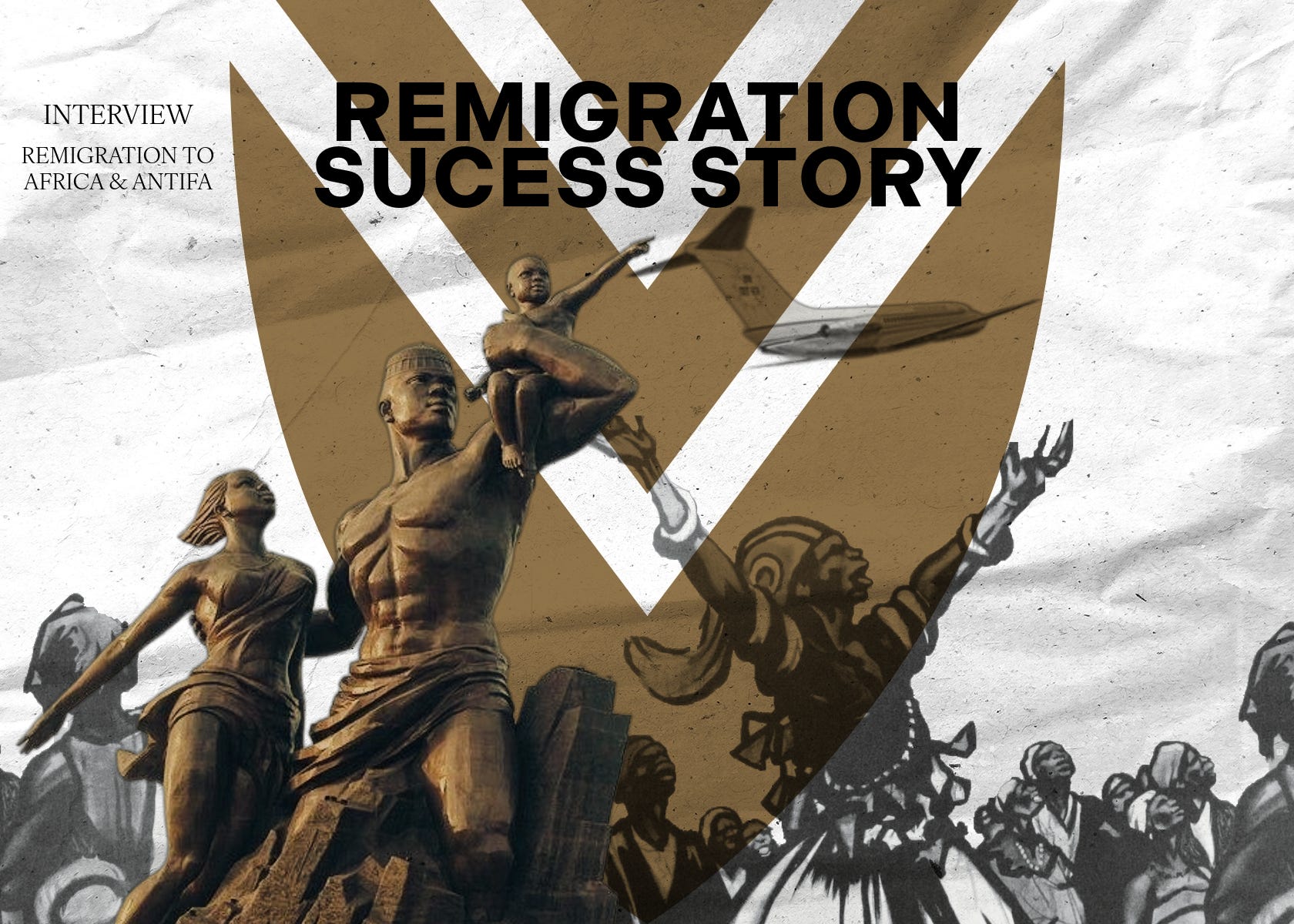
Today, “remigration” has become a flashpoint for tensions. Since the 2010s, the concept has been adopted by identitarian circles as a response to the “Great Replacement” theorized by Renaud Camus. Once a fringe idea, it has steadily gained visibility. In France, Éric Zemmour placed it at the center of the 2022 presidential campaign, promising a “Ministry of Remigration.” Across Europe, the November 2023 “Potsdam meeting,” involving Martin Sellner, entrepreneurs, and officials from the Alternative für Deutschland, acted as a catalyst. Sellner later published Remigration, Ein Vorschlag, elaborating on his project. Today, remigration is at the heart of public debate, including within the political right.
“Remigration” is more than a slogan—it is a full-fledged project. This is the story of one man who decided to apply, to himself, the principles he advocated. Writing under a pseudonym for safety, Henri de Turenne agreed to share his journey. Known in French-speaking Twitter circles with nearly 26,000 followers, he chose to move from ideas to action. His testimony seeks neither to persuade nor to provoke. It simply lays out a path. Each reader is left to draw their own conclusions. Here is his story, unfiltered.
1. Could you introduce yourself ?
I prefer not to share my real name for safety reasons. On Twitter, where my account has reached 26,200 followers, I am known by the pseudonym Henri de Turenne, a tribute to the great French general I greatly admire. I can tell you that I am 35 years old, have spent much of my life in France, and decided to return to my country of origin in 2022.
2. What motivated you to come to Europe, and what did you actually find in terms of opportunities and lifestyle compared to what you imagined ?
I was born in Senegal. I came to France at the age of five, in December 1996, with my mother and my two older brothers. My father was already in France, initially living without legal status and making a living by giving private math lessons. During a conversation with members of an organization that helped undocumented migrants, he mentioned that his father (my grandfather) had fought for France during World War II, taking part in the landing in Provence on August 15, 1944. My grandfather’s father (my great-grandfather) had fought in the First World War and had been injured by gas at Ypres in 1915.
Following this, my father contacted his parents to send all the necessary military documents and diplomas to secure his regularization. Not only was he granted legal status, but he—and by extension his family—was “reintegrated” into French nationality under Article 153 of the French Nationality Code. This is how I was able to come to France with my mother and brothers. We lived in a public housing project in Draveil, in the Essonne department, where I went to school and quickly integrated, even though at first I didn’t speak a word of French—only Peulh, my mother tongue.
3. You chose to get politically involved in France. How did that start, and how did your visibility expose you to confrontations with your ideological opponents ?
My political engagement came about through a combination of factors. First and foremost, I have loved history since childhood. I remember, in elementary school, being starry-eyed when the teacher spoke about Mesopotamia, ancient Egypt, Greece, and Rome. I was also fascinated by the library books with illustrations of ancient cities like Athens, Rome, or Alexandria. That passion for history has never left me.
I went on to earn a literary baccalaureate in 2010 and then pursued a degree in history. Despite my love for history, I had been raised on republican propaganda, taught that France’s history was dark during the Middle Ages and the Ancien Régime, and only became enlightened starting in 1789. A brilliant professor during my degree changed my perspective, revealing the reality: French history was glorious throughout, and the monarchy was nothing like what we had been taught in primary and secondary school.
At the university library, I devoured countless books, especially biographies of French kings. Reading Alexis de Tocqueville’s The Old Regime and the Revolution finally convinced me. Around 2013–2014, I also began watching “reinformation” videos online, including content by Soral and Le Raptor Dissident, which offered a very different perspective for someone like me who grew up in the Paris suburbs, where left = good and right = bad.
The decisive moment in my politicization and rightward shift was meeting a university friend who was an active member of Action Française. Through our conversations and discussions, my understanding of France and what it should remain became clearer. I started accompanying him to certain Action Française events, and it was through these that my first confrontations with leftists and antifascists began.
4. You have been attacked multiple times by antifascist activists. How did you experience these assaults, and what do you think about the violence of the far left in France today ?
As I mentioned in a tweet on February 18, I’ve had several run-ins with antifas and the far left. After my first public appearance—where I went “viral” in a video during the Yellow Vest movement, explaining what I saw as the left’s manipulation of racial minorities to create a captive electorate and arguing that France has historically been white and should remain so—I was recognized several times on the street. Surprisingly, it wasn’t people of color who confronted me, even though some disagreed with my ideas; it was white, bourgeois leftists.
One evening, returning from a night out with friends I had met at university, I was confronted by antifas in the Latin Quarter, near the Cluny–La Sorbonne metro station. Having recognized me, they tried to snatch the MAGA hat I was wearing that night. A fight broke out. I took quite a few hits, I landed some too, but above all, I managed to keep my hat.
Another time, I accompanied my friend from Action Française to the commemoration of the November 11, 1940, demonstration—organized by students, including members of Action Française, and harshly suppressed by the German occupation authorities. This commemoration takes place each year on the Champs-Élysées, near the site of the Qatari embassy, where a plaque commemorates the event. That day, we spotted about ten antifas lurking around, trying to intimidate us with throat-slitting gestures. A member of AF, with the name of a Frankish king, approached them to ask their intentions. A fight then broke out. We all came to support each other and delivered what we saw as a firm and fair response.
During the Yellow Vest movement, I also witnessed various incidents and clashes with leftists and antifas trying to infiltrate and distort the movement—something they ultimately succeeded in doing, unfortunately. Then came COVID, and I focused more on my work, having secured a job as a history teacher at a private secondary school, so I no longer faced direct confrontations. However, I often went on an app called Discord and observed the left’s intolerance there: no debate, no presence, no right-wing ideas were tolerated on their servers, whereas right-wing servers always had leftists among them or invited them to debate. This is how I saw where fanaticism, intolerance, violence, and malice truly lay—a reality that the Quentin case painfully reminds us of.
5. Have these confrontations changed your perception of French society and your sense of belonging ?
These confrontations didn’t change my perception of French society or my sense of belonging, but they did convince me that living in a society alongside leftists was impossible. Their goal is to destroy society and the French nation, whereas ours was to preserve as much of it as possible—a task already severely compromised since the waves of mass immigration began in the 1960s and 1970s.
I was also frustrated by attempts at dialogue, exchange, or debate with the destructive camp of the left, which, whenever it can, socially—and sometimes even physically—targets its right-wing opponents: doxxing them, tracking down their jobs, contacting their banks, sabotaging commercial partnerships for right-wing influencers, and so on. I therefore decided to cut all ties with these people, except, of course, in family contexts, which are more complicated.
My perspective is that leftists are not loyal opponents with whom one can debate and persuade using rational, well-founded arguments—they are mortal enemies. Apparently, in 2020, this view was considered a bit too radical, as many of my friends at the time disagreed and thought I was far too extreme.
6. When did the idea of returning start to take shape? Was there a specific event, or was it a gradual realization ? How did your circle in Europe and Africa react to this decision ?
The idea of returning gradually took shape around 2020, during the lockdown, when I had a lot of time to be alone with my thoughts. How could I advocate for remigration while staying in France? Was I not, despite myself and despite my love for France, an agent of the Great Replacement? Slowly, the notion took root that I had to put my ideals and beliefs into practice; otherwise, it would amount to a certain kind of hypocrisy.
My family and friends reacted in different ways. My father had already returned to Senegal upon reaching retirement, and my mother was planning to do the same. They were therefore happy that we could be reunited there. My friends, on the other hand, were rather sad about my choice. Many told me that I was fully assimilated and had an unbounded love for France, yet I was leaving while France continued to welcome every year people who hate the country. “It’s not the best who should leave,” they said, “but the social misfits who make life miserable for everyone.”
Despite this, my decision was made. The 2022 election and Macron’s victory only reinforced it—France, the country I loved, was in the process of self-destruction, by the very choice of the French themselves.
7. How did you go about settling in your country of origin? What obstacles did you encounter, and how did you overcome them ?
In May 2022, I flew to Dakar, the capital of Senegal, where I have family, including my father. My mother joined me the following year. With a bachelor’s and master’s degree, I managed to find a job after about four months—unfortunately, it had nothing to do with my passion for history, but it is still engaging and fulfilling.
Having saved some money, I also invested in a business. Four years later, the business is running successfully and allows me to live comfortably without even needing to touch my salary from the company that employs me. By the standards of a West African country, I can therefore consider myself fairly well-off.
8. In what way do you consider your return a success today ?
I am now married and the father of a young boy, and in retrospect, I am quite happy with my decision. I am on the land of my ancestors, have been able to start a family—which I hope to grow soon—have launched a business that created four jobs and supports several families, and I pay taxes to the Senegalese state, which I hope will put them to good use. Yes, I believe my return has been a success, both personally and professionally.
9. Do you identify with the term “remigration” ? In your view, what conditions are necessary for a return to be successful and fulfilling ?
I fully identify with the term “remigration,” especially since, having been born abroad myself, I was an immigrant in France, even though I obtained French citizenship. I couldn’t say definitively what makes a return successful. I imagine that one must be motivated to contribute to one’s true homeland—the “land of the fathers,” where our ancestors are buried—which is not the case for the vast majority of immigrants, even those born in France, of the second or third generation.
Every journey is different, but with access to quality education and training, many immigrants could and should use their talents to benefit their countries of origin, particularly in Africa. I realize our countries are not going to become South Korea or Switzerland overnight, but it is certain that fleeing to Europe for a more comfortable life will not help advance the continent.
10. If you had to give advice to someone hesitating between staying in Europe or returning, what would you say ?
If I had to give advice to someone torn between staying in Europe or returning to Africa, it would, of course, be to go back. Return for your dignity, because by working in France, you are giving your labor, taxes, contributions, and skills to a country that is not yours—and never will be. Assimilation, which literally means “to make alike,” only works among Europeans, and even then, there were difficulties. I remind you that a large number of Italians and Poles who arrived in the 19th and 20th centuries eventually went back.
I am speaking especially to those who promote indigénist or victimhood narratives, accusing France of systemic racism and all that nonsense. Go back to Africa—there, you won’t suffer discrimination because of your skin color, your name, or your religion. Stop suffering on this continent and return to put your talents to work for Africa, which is waiting for you.
If you, too, are non-European and have chosen to practice remigration, contact us to share your story. Your experiences help shed light on this choice and reveal its many facets. Contact : voxeuropa.eu@gmail.com
Voxeuropa Herald is an initiative that shares the voices shaping Europe today: elected officials, essayists, philosophers, activists, artists and influencers. These portraits are collective responses to the crises shaking our Europe. Faced with the major upheavals of our times, Voxeuropa Herald gives a voice to those who, throughout Europe, share solutions and visions for the future. The message is clear : European realities call for European responses.
🔹 Follow Voxeuropa on : X | Instagram | Telegram |
🔹 To support us - Paypal
🔹 Share, comment, and debate — ideas gain power when they circulate.
I was actually banned from remigrating because of my childhood mental illness label and the fact that I wasn't born in China.
So I advocate for a hybrid model called the Dubai Model, where VHCOL cities in America operate with the same situation of limited citizenship recognition as cities like Hong Kong or the UAE cities.