


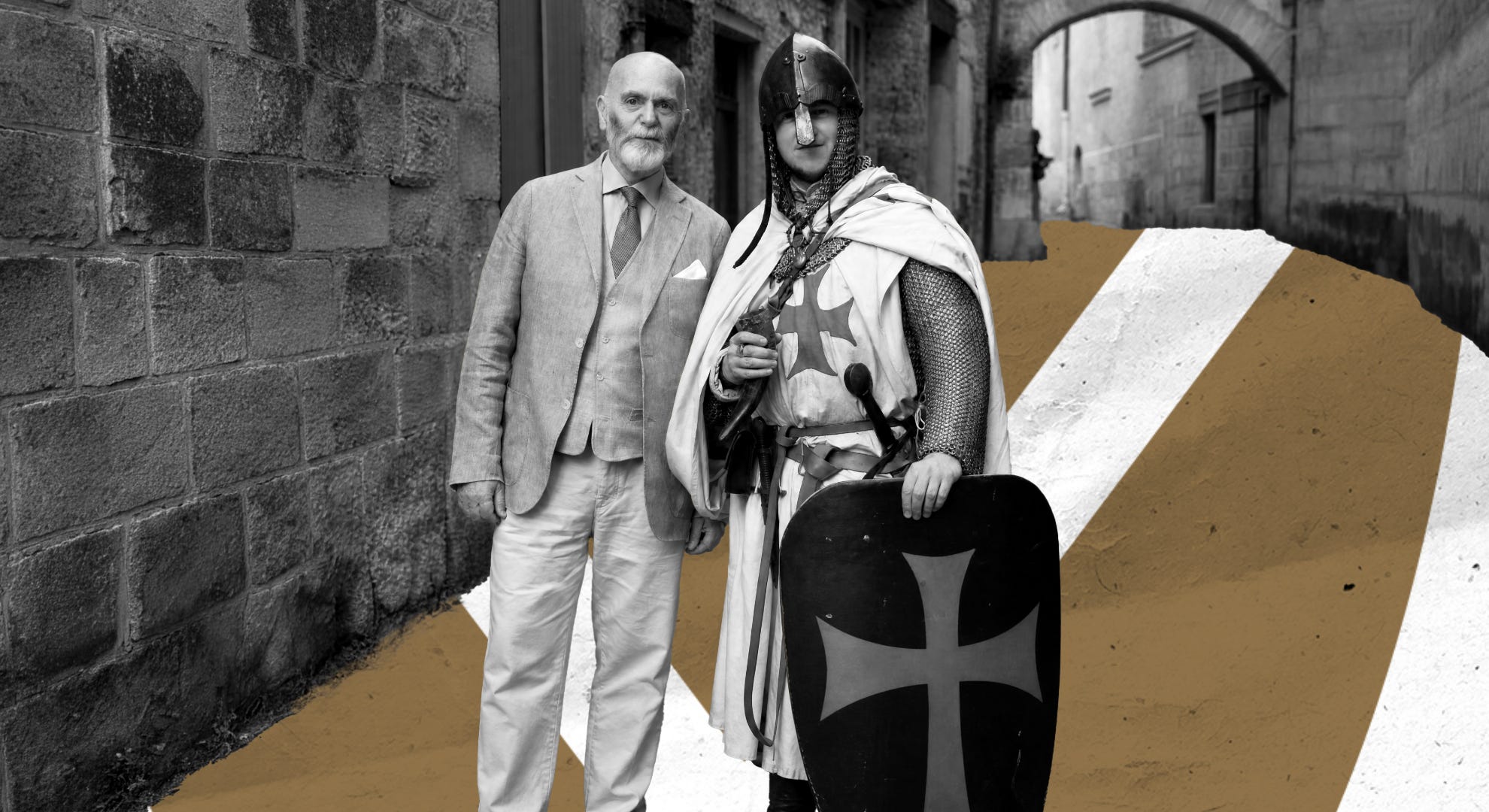
Renaud Camus, born in 1946 in Chamalières, is one of the most singular intellectual figures in contemporary France. Trained under Roland Barthes, recipient of the Prix Fénéon in 1977 and the Prix Amic of the Académie française in 1996, he was first recognized as one of the great stylists of his generation, the author of a considerable body of work blending the personal diary, elegies, novels, writings on art, and philosophical essays. It was in 2011 that his name crossed the boundaries of the literary world to assert itself in global political debate, with the publication of Le Grand Remplacement, a concept he conceives not as a conspiracy theory but as a demographic observation: the substitution, accelerating in pace, of European peoples on their own soil. Founder of the Parti de l’In-nocence (2002) and the Conseil National de la Résistance Européenne (2017), settled for thirty years at the Château de Plieux in the Gers, Renaud Camus continues to write, publish, and speak out, including in the face of travel bans, such as the one served upon him by the United Kingdom in April 2025, which prevented him from delivering his speech on remigration at the Big Remigration Conference. Voxeuropa gives him the floor to lay out, in their entirety, the theses and vision of a writer whom the age has rendered unavoidable.
You were trained under Roland Barthes, you received the Prix Amic of the Académie française, you organized art exhibitions: you are, first and foremost, a man of letters and art. How do you explain the transition from that world to the political and conceptual engagement for which you have been known since the 2000s? Was there a decisive moment, a tipping point?
No, there was no decisive moment, no tipping point. I have always been obsessed with the question of truth, and I have always thought that the writer’s mission was to make his way to the blind spots of a society, those which, despite their obviousness, eluded public expression, which were the object of a concealment, whether deliberate or mechanical. The change of people and of civilization was at once the largest and most glaring of these blind spots: an enormous, gigantic phenomenon, the most significant in European history in centuries, and one that everyone affected not to notice.
The word “people” is at the heart of your thinking. Yet it is a word whose definitions proliferate and contradict one another: civic people, ethnic people, cultural people, historical people. What precisely is the definition you give it, and what, in your view, grounds the legitimacy of a people on a territory?
I am somewhat surprised by your assertion. I had not noticed that the word “people” was so important to me, but you may be right. It is with that word as it is with all essential terms, those most deeply inscribed in the history of a language: definitions chase after them in vain without managing to pin them down. The more things and concepts simply are, the harder they are to define: take race, identity, nation, and so on. I believe in history, in myths, in etymology, in the depth of time. It is history, it is time, it is works and myths that give peoples and races rights over which even democracy cannot prevail. When the Chinese change the population of Tibet, which is one of the most perfect paradigms of the Grand Remplacement, they do not abolish, even if they trample upon it, the right of the Tibetans to be masters of their own fate and their own country.


Jean Raspail said he was “disappointed to have been right.” You have seen close friends distance themselves from you, you have been convicted, associated against your will with acts you condemn, and yet the facts you were describing continue to impose themselves on public debate, even from the mouths of heads of state. How does one live in this singular position: that of a man whose theses are gaining ground while he himself remains persona non grata?
Oh, I have had time to get used to it, and my temperament perhaps means I suffer from it less than others would. No, what is despairing is not that. What is despairing is that the Grand Remplacement as observation spreads far more slowly than the Grand Remplacement as fact, as the dreadful fact, the genocide by substitution, the destruction of the Europeans of Europe and their civilization. By the time Europeans realize what is happening to them, they are already in the dustbin of history, like the Medes, the Mayas, the Picts, or the Moriori of the Chatham Islands, whose foundational law, the Nunuku, forbade them from defending themselves against an invasion, on account of which they welcomed the Maori with open arms, who then slaughtered them or reduced them to slavery.
You distinguish the Grand Remplacement as demographic phenomenon from an ideology you call “global replacism,” a convergence of economic, media, and political interests that organize or tolerate this replacement. Can you describe the actors and mechanisms of global replacism as you conceive it?
The Grand Remplacement, however gigantic it may be, is only a very small part, yet it is the culmination, the crowning achievement, the summit, of what I have indeed called global replacism. Men and peoples are replaced, but that is merely the sinister completion of a mechanical enterprise immeasurably vaster still, within which everything is replaced by everything. The Grand Remplacement is not a theory; it is a name for a phenomenon, a name for an era and for its defining phenomenon, a chrononyme (a name that designates an era by its dominant event); and at the same time it is a crime, obviously, the crime against humanity of the twenty-first century (and that crime is committed by those who call it a “theory”). Global replacism, far broader, is at once a theory, a totalitarian ideology, and a power structure whose politico-economic form is davocracy, the managerial governance of the human park by Davos, the multinationals, the banks, the hedge funds, Big Tech, and the Big State; their armed wing is the Genocidal Bloc, an ensemble of judges, journalists, organic intellectuals, and elected officials who owe everything to replacist davocracy and who without it would be nothing.
The theory of global replacism rests on the observation that replacement is the central, essential gesture of industrial and post-industrial societies (though they remain industrial, and are more so than ever when they are entirely digital). Everything in them is replaced by everything: original materials by their cheap imitation, literature by journalism, culture by subculture, music by noise, names by first names, workers by machines, men by women, men and women by robots, Europeans by Africans, the economy by finance, finance by digital management, intelligence by artificial intelligence, and so on. Plastic is the sovereign material of global replacism, and it pollutes not only the oceans and our lungs. The societies of global replacism are a universe of the copy, the double, the ersatz, the imitation, the counterfeit, the simulacrum, the facsimile, the substitute, the assimilation. It follows, moreover, that the false is consubstantial with them. This is what I have called the faussel, the false real, the fake real, an imaginary world in which what happens does not happen, a sort of generalized Truman Show in which information is a filter and a death philter, in which even grief, suffering, and pain, which once passed for the ultimate proof of the true, are assimilated to “recuperation”: if you weep over the crimes of global replacism, you are merely “recuperating” them.
The concept of Undifferentiated Human Material (MHI) is one of your most original contributions to the debate, the idea that the global economic system treats human beings as interchangeable units, without rootedness, without belonging. Does this concept appear to you as a legacy of classical liberal tradition pushed to its conclusion, or as something more specific to our era?
Both: Undifferentiated Human Material, interchangeable at will, is the result of a very long process that can be dated to the Industrial Revolution, or even to the crisis of European consciousness, to use Paul Hazard’s phrase, or even to that great revolution in Western consciousness that took place in Europe at the beginning of the seventeenth century with a Descartes, a Huygens, or a Galileo. Man, especially from the Second Industrial Revolution onward, the American one, Taylorism, Fordism, the aptly named assembly line (inspired by the Chicago slaughterhouses), finds himself progressively stripped of all his belongings: family, province, nation, culture, class, race. He is liquefied, like the society around him, as magnificently attested by the work of Zygmunt Bauman. Dispossession and liquefaction are the prelude to liquidation, whether it manifests through genocides and de facto eradications, or through a genocide by substitution, by replacement, like everything else. In the societies of global replacism, even genocides are by substitution.


You have devoted several books to what you call “decivilization” and the “great deculturation,” and in particular to the collapse of language as the primary symptom of that decivilization. As a writer deeply attached to the ample sentence and to style, how do you assess the state of the French language today? Are there still places where it holds its ground?
Oh, I have no doubt there are places and individuals where it holds its ground as best it can, often valiantly, sometimes brilliantly. But on the whole, and since we were speaking of liquefaction, it has been very gravely affected. Before our eyes, as if under the effect of a permanent heat wave, entire sections of its structure are melting: tenses no longer exist, moods have disappeared, a thousand concordances are no longer made. At every moment one must double the subject (”La France, elle…,” “le problème il est là…”), as though one feared that, too weak, too ill, it might not hold out until the verb. People understand each other less and less, between themselves and within themselves. That said, I do not believe this is specific to the French language. The contemporaries and victims of global replacism increasingly outsource their thinking to machines.
To extend the question to what you call “decivilization” and the “great deculturation,” seeing in the collapse of language the primary symptom of a broader collapse: yet this severing between a people and its language does not affect French alone; German, Dutch, the Scandinavian languages are undergoing comparable mutations. As a writer deeply attached to the ample sentence and to style, do you think we are witnessing a properly European phenomenon, the simultaneous dissolution of all the great civilizational languages of the continent?
I think we are witnessing a worldwide phenomenon, a sort of infantilization of the species to which music and sound amplification, dance and trance, drugs, show business as the spectacle of the world, football as the opium of the people, fan culture, mass stupefaction, the education of forgetting, the collège unique, and the eradication of the cultivated class have greatly contributed, curiously concurrent with the eradication of the peasantry.
Since 1992, you have lived at and animated the Château de Plieux in the Gers, where you have organized colloquia, contemporary art exhibitions, where you paint and write your diary. Is Plieux, for you, a form of concrete resistance to decivilization? A laboratory of what a rooted life might be?
Yes, undoubtedly, to a certain degree, although I have not organized public activities there for a long time now, neither colloquia nor exhibitions. I believe very strongly in a politics of sanctuaries, quite similar to that of the monasteries in the early Middle Ages, in the time of the Great Invasions. We need sanctuaries for beauty, sanctuaries for culture, sanctuaries for the life of the mind, sanctuaries for music, sanctuaries for silence, sanctuaries for solitude. It was to allow for solitude that civilization was invented, paranoia, the pact of in-nocence (etymologically: the state of causing no harm), the less for the more. We need strongholds for resistance, where what can be preserved may be preserved for future generations, and which can serve as bases for a most desirable reconquest, indigenist and decolonial.
Remigration is defended by politicians, activists, and demographers. But you are a writer, and you defend it with words no one else uses: beauty, landscape, the sentence, mourning. What does literature bring to this debate that politics cannot?
A trembling of meaning, perhaps, as Chateaubriand speaks of an “admirable trembling of time,” for the hand of painters of genius in their old age. An unrealism, an incompetence, a contempt for paralyzing contingencies. Specialists do not see things, they are too close. Experts blind themselves and blind us, because they take into account too great a number of data points, which conceal from them the obvious. Nine-tenths of sociology over the past fifty years has been nothing but an enormous enterprise of concealment, a garrulous negationism in the service of genocidal global replacism.
In April 2025, you were denied entry to the United Kingdom to deliver a speech on remigration, the British state deeming that your presence was “not conducive to the public interest.” That speech was ultimately published under the title The Bourne Speech. How do you interpret these travel bans that are multiplying against European intellectuals and activists?
The Genocidal Bloc is impatient to bring the genocide by substitution to its conclusion. It sees the finish line; it tells itself it is nearly there, that soon the liquefaction of the species will be total and the Dummy World beyond return and without escape since it will be universal. At the same time, the proximity of absolute victory makes it nervous; it lives in fear that a spark of truth might set everything ablaze at the last moment. This heartening nervousness lays it bare in its totalitarian reality. Bans multiply, convictions rain down, ruinous fines fall from every direction. I have just again been summoned to the gendarmerie for “incitement to racial hatred” because I referred in a tweet, regarding Saint-Denis, to the négropole des rois (literally: the necropolis of kings, a traditional epithet for the royal basilica of Saint-Denis, here repurposed by Camus as a demographic observation). Hatred is the name the Genocidal Bloc gives to any objection to its crime. Nothing less than this relentless repressive lead blanket is needed to sustain, against the possible infiltrations of truth, the neo-negationism of the state, that faussel we have just seen to be consubstantial with genocidal global replacism.
You think, write, and fight first in French, but your reach has become resolutely European and even worldwide. What does it mean, to you, to be European in the contemporary context? And do you think that French identity and European identity are complementary or in tension?
Oh, perfectly complementary. I feel as European as I am French. A cultivated Frenchman of former times was entirely steeped in European culture. The Romanesque art of Saxony or Old Castile was as familiar to him at first glance as that of Burgundy and Auvergne. Shakespeare held as much place in his reverie as Corneille or Racine. He was perfectly willing to acknowledge Turner as the greatest European painter. It could very well happen that Leopardi was more precious to him than Lamartine, and Gustav Mahler than Fauré. A Sartre or even a Camus counted for little beside a Heidegger. He found Norway even more beautiful than Scotland, and Scotland more overwhelming than the Artense or the Cézallier (two high plateau regions of the Massif Central, bywords in Camus’s writing for the deep, unhurried heartland of European landscape). Away with colonial countries, he said with Barnabooth, that have for them only the wonders of nature, and have not even managed to procure themselves a Theocritus. And with Rimbaud: I long for Europe with its ancient parapets. Alas, today the colonial countries, and in any case the colonized ones, are ours.
Our readers are European, French, German, British, American, Norwegian, united by the feeling that something essential is in the process of being lost. What message do you address to them?
Revolt! Come out of your closets! Leave anonymity behind! Take to the streets! Break nothing! Steal nothing! Be in-nocent (cause no harm)! Do not kill, do not wound, do not be malicious, it makes one base. Be bathmological: distinguish, segregate, discriminate. Degrow and discriminate. Between equality and truth, make your choice; you cannot love both. Deepen inequalities, read a book! Make yourself unequal to yourself. Do not hate, it does too much honor: despise, if need be, then despise your own contempt. Love races, skin colors, nuances of soul, cultures, civilizations, Arab architecture, African art, Belgian music, César Franck, Guillaume Lekeu, the marvelous diversity of the world, which replacement diversity smothers. Do not be xenophobic; defend the foreignness of the Earth and of beings, which global replacism is assassinating. Rid yourselves of music, or on the contrary return to music, which was the soul of Europe, and which Europe is dying of having trampled in favor of Afro-industrial trance, that drumbeat of luminous, blinking pipes in the pre-posthumous resuscitation wards. Trance is the consort of all the trans: class defectors, race defectors, sex defectors, defectors from truth, itself a defector from the camp of the victors, to paraphrase Simone Weil. Care nothing for your retirement savings; it is through them that the davocratic Machination holds you. Throw away your calculators! Be ignorant of the price of things; concern yourself only with their value and the joy they give you. Numbers are what has lied to you most. Remember that the only indigenous people in Europe is you! The only legitimate decolonials, too. Decolonization and remigration are synonymous. Return the colonial occupant imposed upon us to his homelands, and the occupier to his sordid calculations.
Voxeuropa Herald is an initiative that shares the voices shaping Europe today: elected officials, essayists, philosophers, activists, artists and influencers. These portraits are collective responses to the crises shaking our Europe. Faced with the major upheavals of our times, Voxeuropa Herald gives a voice to those who, throughout Europe, share solutions and visions for the future. The message is clear : European realities call for European responses.
🔹 Follow Voxeuropa on : X | Instagram | Telegram |
🔹 To support us - Paypal
🔹 Share, comment, and debate — ideas gain power when they circulate.