


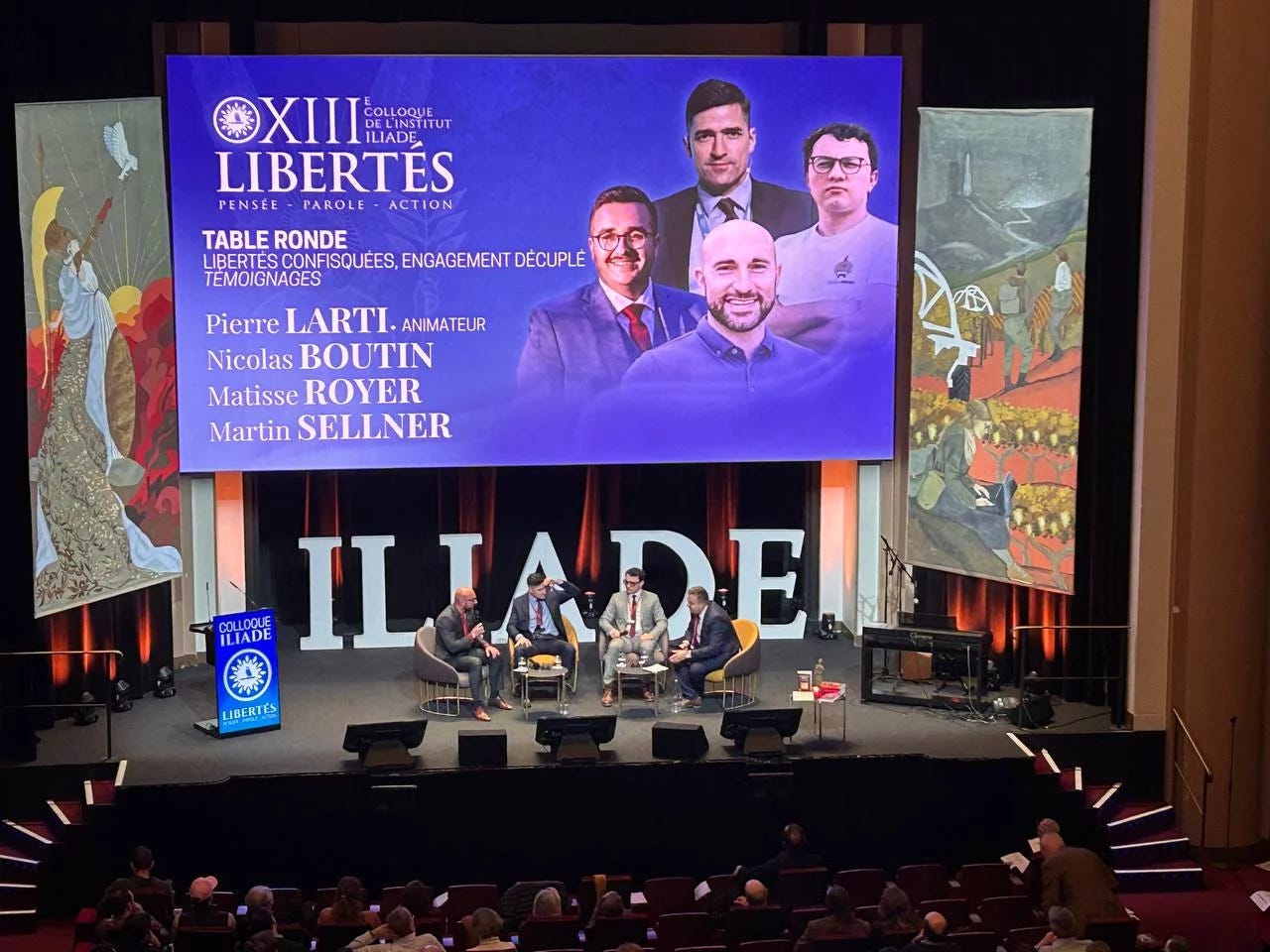
Three days before the thirteenth annual symposium of the Institut Iliade, a La France insoumise MP wrote to the Interior Minister demanding it be shut down. Five months earlier, the administrative court had already struck down an identical order. The legal defeat has not discouraged its authors. It has simply laid bare what the procedure is now for. What Thomas Portes wanted to keep out of sight, the April 11 symposium put on full display: a European right in the midst of consolidation.
I. What the left tried to ban
The ritual of preemptive censorship
On April 8, 2026, Thomas Portes, MP for Seine-Saint-Denis, sent a letter to Interior Minister Laurent Nuñez and to the Paris Prefect of Police. He called for the administrative banning of the Institut Iliade’s annual symposium, scheduled for Saturday, April 11 at the Maison de la Chimie. The grounds he invoked are worth weighing carefully: “calls to hatred and racist remarks liable to be made there.”
Liable. That single word carries the entire argument. The point is not to sanction an act that has been committed, but an act that might be; not to prosecute speech that has been uttered, but speech attributed to the speakers before they have opened their mouths. This is a departure from the rule of law, which sanctions acts, in favor of a preemptive policing of opinions.
The maneuver is all the more revealing given its place in a losing legal sequence. In November 2025, the Paris administrative court struck down a prior ban targeting the Institut Iliade and ordered the state to pay court costs. The decision should have set a precedent. It changed nothing. Winning the legal battle is no longer the point. The point is to make the event, year after year, costly, stressful, politically exposed. The ban, however doomed in court, has become an instrument of ritual harassment. The procedure says a great deal about the balance of forces: the left has nothing left to oppose the right with but censorship and violence.
A program no one dares to read
What was an elected member of parliament so afraid the audience might hear? The program, published several weeks in advance, contains none of the signals that a procedure invoking “racist remarks” might reasonably be expected to cite. Antoine Dresse on liberties without institutions. Laurent Obertone on the medieval mindset as an inner resource. Alice Cordier, of the Collectif Némésis, on women’s liberties as a constant of European identity. Jean-Luc Coronel de Boissezon on academic freedom. Philippe Herlin on economic liberties. Thibault Mercier on the twilight of liberties. Jean-Yves Le Gallou closes the day on how to escape what he calls “anarcho-tyranny.”
A program in political philosophy. The morning begins with a fable, recited by an actor. Musicians play guitar, violin, bagpipes. The day closes at eight in the evening with a grand ball. Thomas Portes did not want to ban what was going to be said. He wanted to ban what was being built. The two are not the same.
II. What it saw anyway
Context: Quentin
One backdrop must be named, the one the left-wing press erases entirely: the murder of Quentin, a nationalist student, killed by hard-left militants close to La France insoumise. The investigation has identified six suspects.
The event had its effect: it woke people up and drew them in. The stands saw new crowds. Young people with little prior political involvement enrolled in the institute’s training cycles. And when an MP from the party whose name the alleged killers invoked demanded the symposium be banned three days before it took place, the gesture was received for exactly what it was: a provocation, and an admission.
An audience no one wants to describe
The French press carefully avoids describing the people crowding Rue Saint-Dominique from half past nine in the morning, a stone’s throw from the National Assembly. An audience mostly of men and women, well-dressed, with a large share under forty. In the hallways one hears French, Italian, English, Spanish, Serbian, German. A Norwegian publisher runs a stand devoted to the writings of Fridtjof Nansen.
A cultural front taking shape
What changes everything is the international composition of the event. Five years ago, Junge Freiheit would not have sent two reporters to Rue Saint-Dominique, Compact would not have been there, and Benedikt Kaiser would not have been signing, in Paris, the French translation of his Gramscian analysis of the AfD’s success, six months after it came out in Halle.
Things have changed. Martin Sellner’s book Remigration sits on the stands in several translations. Jean-Yves Le Gallou, former MEP and a historic figure of GRECE and later of Iliade, has just published Remigration: Pour l’Europe de nos enfants, conceived as a “companion volume” to Sellner’s book. The preface is signed by Sellner himself. The exchange is no longer bilateral; it has become circular. Books travel, authors write each other’s prefaces, ideas are translated in real time.
The many structures involved no longer merely watch one another; they interpenetrate. This articulation is precisely the anchor point that a part of the European right has been looking for: a physical space where different sensibilities meet face to face: traditional Catholics, pagans of the Nouvelle Droite, liberal-conservatives, identitarians, nationalists. An intellectual ferment rather than an orthodoxy. Paris, once a year, plays that role.
The event’s cultural depth confirms that this is not merely a political platform. Paintings in the corridors, theater performed in pieces on the main stage, traditional music between sessions. Alongside the symposium, the announcement of a new “Nietzsche” training cycle for young Europeans was met with strong enthusiasm, a sign that intellectual demand is outrunning existing offerings.
The lineage is long. A guest interviewed by Junge Freiheit summed up the moment in two words: he spoke of “GRECE families” and noted that the present-day audience is “essentially the third generation.” Founded in 1968 by Alain de Benoist and a handful of others, among them Dominique Venner, to whose memory the Iliade was dedicated in 2014, GRECE was more than a circle. It was a school. Its first students are now between seventy and eighty-five. Their grandchildren, the people one saw on Saturday, are its living embodiment.
On the podium : Sellner, Boutin, Royer
Late in the afternoon, the roundtable “Confiscated liberties, redoubled commitment,” moderated by Pierre Larti, brought together Martin Sellner, the leading figure of the Austrian Identitarians; Nicolas Boutin, journalist at Valeurs actuelles; and Matisse Royer, founder of Voxeuropa. Sellner spoke in French, with a lightness of touch. He recounted the bans, the no-platformings, the bank account closures (116) he has faced in Austria and Germany. He called them his “decorations.” He closed, to general laughter, with a line that captures his method: “Danke, Antifa!” Repression, he explained, regularly misses its mark: it designates, it aggregates, it makes visible.
Boutin brought the perspective of a French conservative press that has been steadily rearming itself intellectually. Royer closed the roundtable with this intervention:
“If millions came, then millions will leave. If Spain lived seven centuries under Muslim rule, then nothing is lost. Europeans once ruled the world. We are conquerors, and we will become again what we are. And we will never apologize for it.”
The line places remigration, a term coined in France and theorized politically by Sellner, within a long arc of time. Seven centuries to reconquer Spain: the Reconquista is no rhetorical flourish, it is a reminder of what Europeans have done, and therefore of what they can do. The refusal to apologize closes the thought on an ontological register. One does not apologize for having been a people. One owns it, or one ceases to be one.
A telling absence
One final element deserves attention: the near-total absence of the Rassemblement National. It points to the enduring misunderstanding between the Nouvelle Droite and France’s main opposition party. Inside the RN, the intellectuals are thought too abstract, too elitist. Inside the Nouvelle Droite, the RN’s dédiabolisation is read as a dilution.
The takeaway is this. The Iliade symposium does not operate as an annex of any party. It operates as a school, independent and free. Which is exactly what makes it, in the eyes of its adversaries, a more formidable object than any electoral machine. An electoral machine can be beaten at the polls. A school can only be beaten by a better school.
What the day made visible
An MP writes to a prefect asking that a symposium be banned. The ban does not happen. The symposium takes place. Fifteen hundred people attend. Journalists from a dozen countries cross paths. Books in four or five languages change hands. What the Portes attempt meant to keep out of sight, it ended up confirming: that the space of European thought has quietly reorganized itself while the left exhausted itself demanding dissolutions. That there now exists, between Paris, Halle, Vienna, Milan, Madrid and Budapest, an institutional, editorial and human fabric that makes the old strategy of national isolation obsolete. That the “intellectual right,” whose death has been announced every five years since 1980, is in 2026 in better structural shape than it has been in a generation. There is no finer ratification than the one an adversary gives against his will.
Voxeuropa Herald is an initiative that shares the voices shaping Europe today: elected officials, essayists, philosophers, activists, artists and influencers. These portraits are collective responses to the crises shaking our Europe. Faced with the major upheavals of our times, Voxeuropa Herald gives a voice to those who, throughout Europe, share solutions and visions for the future. The message is clear: European realities call for European responses.
Source photo : Junge Freiheit
Voxeuropa Herald is an initiative that shares the voices shaping Europe today: elected officials, essayists, philosophers, activists, artists and influencers. These portraits are collective responses to the crises shaking our Europe. Faced with the major upheavals of our times, Voxeuropa Herald gives a voice to those who, throughout Europe, share solutions and visions for the future. The message is clear : European realities call for European responses.
🔹 Follow Voxeuropa on : X | Instagram | Telegram |
🔹 To support us - Paypal
🔹 Share, comment, and debate — ideas gain power when they circulate.