


A man smiles from the cover of DER SPIEGEL. Thirty-five years old, in a light-coloured suit, with a square jaw. The magazine portrays him as a dangerous charmer. He remembers people’s names, signs T-shirts, draws his energy from crowds. He wants to smile his way into power. This, apparently, is what a dangerous man looks like in a country where political violence against those labelled far-right has become so commonplace that it almost seems ordinary. Ulrich Siegmund has a face, a name, publicly available addresses, a team. Three of Germany’s biggest newsrooms have published pieces about him of unprecedented severity. And behind him, they have targeted the film crew documenting his campaign: Filmkunstkollektiv
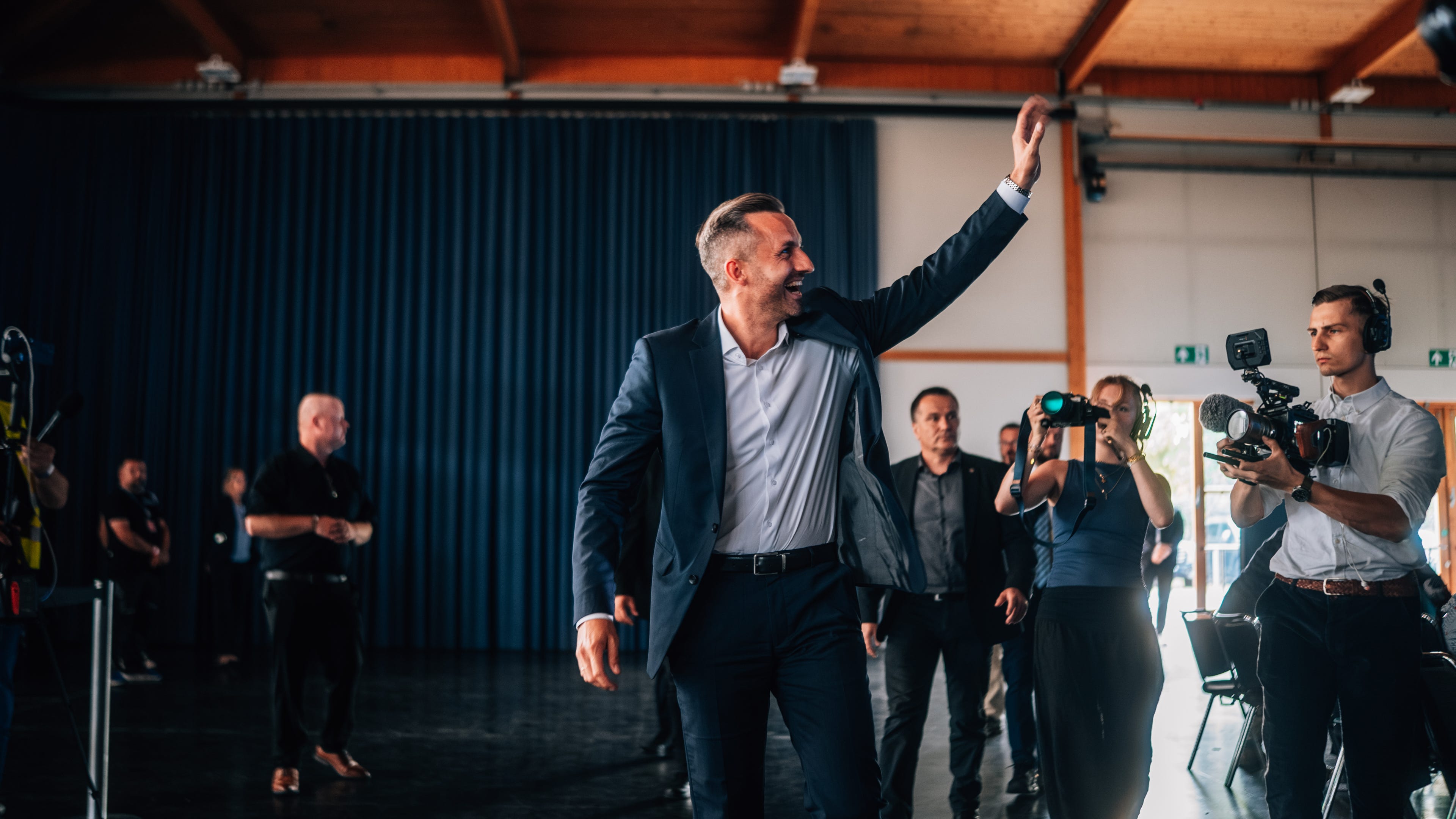
DER SPIEGEL spent months in the field establishing all this. Yet nothing in those months of reporting supports the superlative. Germany’s most dangerous man is not a conclusion. It is a cover decision. It generates fear, and fear sells. Here is how that fear is manufactured.
In 2022, Saxony-Anhalt officially counted 1,270 right-wing extremists. In 2025, it counts 5,100. A fourfold increase in three years. In between, in October 2023, the state Office for the Protection of the Constitution classified the regional branch of a legal political party as a confirmed right-wing extremist organisation—a party represented in the Bundestag, present in every state parliament in Germany, and currently polling at around 42 per cent in Saxony-Anhalt. Its members are now included in the count. The 2022 figure did not include them. The 2025 figure does. The larger the party grows, the higher the number rises. The higher the number rises, the more justified the classification appears. Electoral success has become evidence of danger. The figure is then presented at a press conference, reported as evidence of a surge, fed into newswires and editorials, and turned into warnings addressed to voters.
A resident of Saxony-Anhalt is thus told that his state now contains four times as many extremists as it did three years ago. What he is not told is that two-thirds of them are his neighbours—and that they became extremists overnight because an agency signed a document. On September 6, 1.8 million people are eligible to vote. Remember this mechanism. It governs everything that follows.
A Man Who Had Never Voted
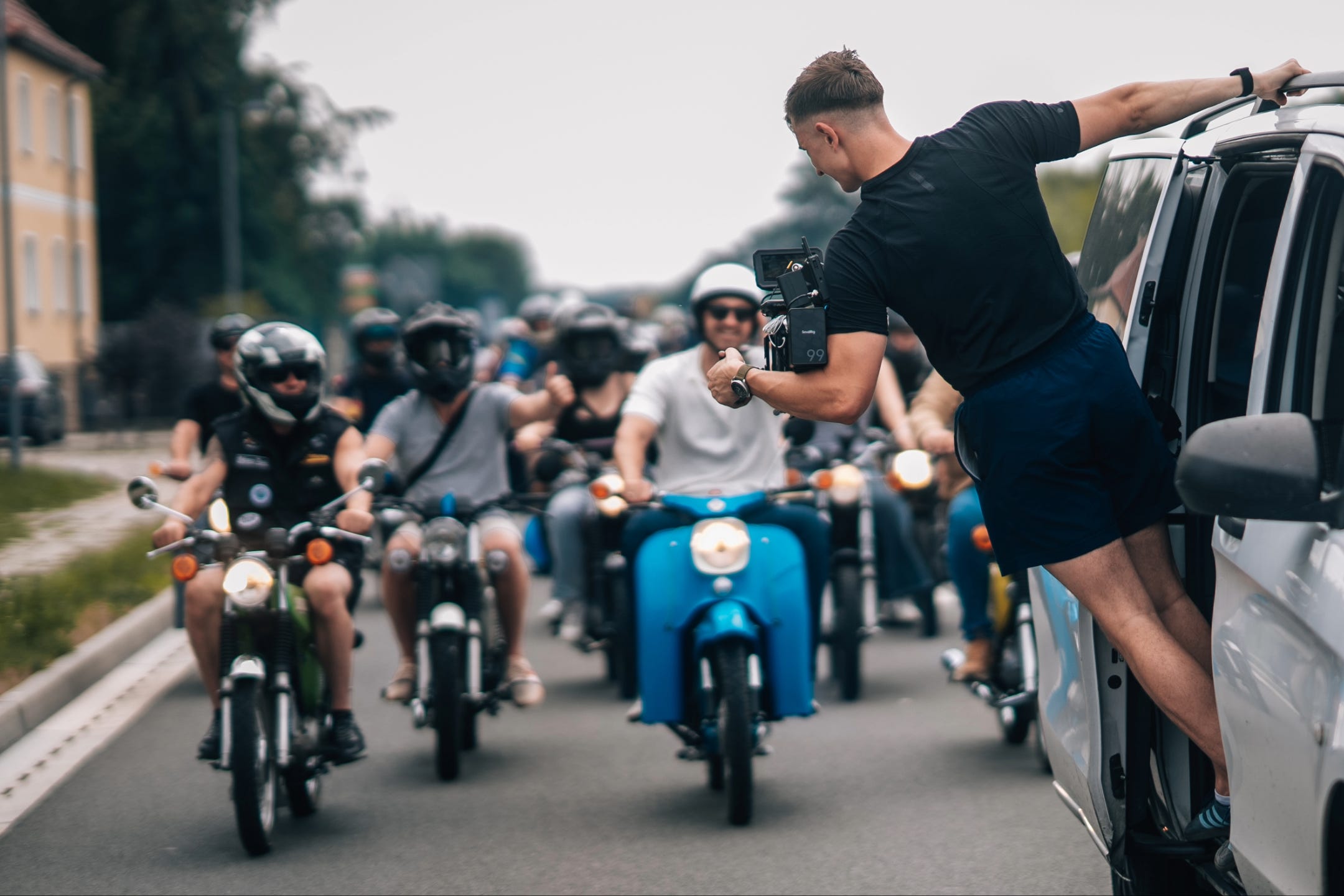
It is the hottest day of the year. More than five hundred motorcycles are lined up on a meadow in Raguhn-Jeßnitz. Simsons: East German two-strokes that rolled out of the Suhl factories in the days of the GDR. DER SPIEGEL, which followed this campaign for months, describes the scene.
There is every kind of person in the convoy. Older men on powerful motorcycles. Couples. Women holding on behind their husbands. Wide-eyed children. And a great many young men. One of them has come alone. He is twenty-two years old: “Ich habe vorher noch nie gewählt. I had never voted before.”
An INSA poll for Bild, dated August 10, puts the AfD at 42 per cent—almost twice the CDU’s score, despite the CDU having governed the state without interruption for twenty-four years. Mainstream newsrooms are on edge. They have published pieces about the AfD, Siegmund and those around him of unprecedented severity. We read them line by line. What they say is less interesting than the way they say it—and what they leave out.
Three Pieces, Three Editorial Categories
The first thing to do is also the most elementary: distinguish between them. The CORRECTIV piece, by Martin Böhmer and published on August 17, is an investigation. Its headline consists of three verbs: march, stage, cash in. Its thesis is that Filmkunstkollektiv, the team producing Ulrich Siegmund’s campaign footage, is not an audiovisual service provider but a structure within the Identitarian Vorfeld, the movement’s broader political milieu, and that it is paid by the AfD parliamentary group in the Landtag. The FAZ piece, published the same day, is not a FAZ news article. It is a Gastbeitrag—an outside contribution published in the Feuilleton, the culture section, written by the author Ines Geipel. No opposing case. No right of reply. No requirement for independent verification. The SPIEGEL piece, dated August 13, is a long-form profile. Months in the field, direct access, interviews.
Filmkunstkollektiv was founded in 2021. Its registered headquarters are in Chemnitz, in a building known to be associated with the Identitäre Bewegung. Several of its members belong to the IB, which does indeed appear on the AfD’s statutory list of incompatible organisations. One of them was convicted over a banner displayed at a swimming pool opposing rapes committed by migrants. In what world is opposing rape a bad thing? The collective attended the Remigration Summit in Portugal in May 2026. It has worked for years with AfD figures such as Björn Höcke. None of this is concealed. Most of it has been published by the people involved themselves, on their own accounts—which, incidentally, are the primary sources for all three articles.
All three pieces rest on the same foundation: Martin Sellner’s now-famous meeting in Potsdam. Siegmund was there. He is said to have laid out his method: present himself as a normal guy, then get the substance across later, under the radar. In other words, a politician is being reproached for having an electoral strategy.
That same meeting became a controversy because of CORRECTIV’s investigation, published on January 10, 2024 under the title Geheimplan gegen Deutschland. But here is what readers in August 2026 learn from none of the three pieces. On March 17, 2026, the Berlin Regional Court II ruled unlawful the central claim of that investigation: the assertion that the meeting concerned a plan to expel German citizens. The court was not addressing some peripheral detail. It was addressing the summary that had turned the piece into a national event—the claim countless newsrooms had highlighted.
Three newsrooms are relying on a January 2024 article whose central summary was ruled unlawful in March 2026. None mentions it. This, apparently, is what we call an investigation. A figure manufactured through an administrative classification. A conclusion struck down by a court and then republished as though nothing had happened. And, as we shall see, an expert presented as an outsider who once ran the campaign of a rival political party. Each piece borrows its credibility from the one beside it. None really possesses much of its own. It is a system that creates the appearance of neutral, professional work. It is a closed loop. It looks impeccable because it carries all the outward signs: official figures, the quoted expert, the anonymous source, the austere layout. What is being manufactured here is not fake news. Something more effective is being manufactured: the system’s own evidence. A professional milieu cites itself, reads itself, confirms itself, and then expresses outrage at what it has just written. The controversy is not a by-product of this work. It is the product.
Propagandafabrik and Hofpropagandisten
Both labels are attributed to Johannes Hillje, introduced to readers as a political and communications consultant who has observed the AfD for years. The description is incomplete, and the omission is not neutral. It serves the circuit described above: an apparently external third
party certifies what the newsroom does not wish to put its own name to, and the reader believes that outside evidence has arrived when in fact it comes from within.
Johannes Hillje ran the European Green Party’s campaign for the 2014 elections. He is a Policy Fellow at the think tank Das Progressive Zentrum. He is the author of Propaganda 4.0 and Das “Wir” der AfD. According to his own professional biography, he advises ministries, political parties and politicians. A former campaign director for a rival political formation is not an outside observer.
The irony is complete. A professional in partisan political communications, without being identified as such, is brought in to discredit professionals in partisan political communications. The word Propagandafabrik describes a profession that the man using it once practised on behalf of another party. As for the technique—having a third party voice an accusation that you do not wish to sign yourself—it has a name in strategic-communications manuals: third-party validation. Hillje teaches it.
We apply the same rule to ourselves. Voxeuropa Herald works with Filmkunstkollektiv. We work with them because we believe they are good at what they do, which is the normal basis of a professional relationship—and it is also what a parliamentary group does when it commissions their work. Readers may weigh everything above accordingly.
Kassieren
The third verb in CORRECTIV’s headline—kassieren, to cash in—carries a third of the thesis all by itself. It is what turns ideological proximity into a funding network.
What is it based on?
A range. Assignments said to be worth between €5,000 and €30,000. The figure is attributed to an anonymous AfD insider. One source. No document, no contract, no invoice, no corroboration. The collective denies the claim and says it works either unpaid or on its own account. The AfD does not respond. And CORRECTIV itself then adds the information that completes the circle: parliamentary groups’ financial reports are not required to itemise this type of service, which disappears into broader accounting categories. The newsroom therefore establishes that its own allegation is, by design, unverifiable. Then it puts it in the headline.
There is also the fact that paying a film crew is not a crime. Every political party does it, using contractors sympathetic to it, and nobody has ever made a headline out of that.
What a Headline Does Not Prove
DER SPIEGEL spent months in the field. Here is what it came away with. Ulrich Siegmund is young, handsome, radical and popular. That is what the profile describes. Germany’s most dangerous man is there only to generate fear. Fear sells. The technique is familiar. What is less familiar is being told that we must regard it as serious, neutral, professional journalism. There are three such sleights of hand.
The first is to have somebody else say it. The harshest words in CORRECTIV’s investigation are not CORRECTIV’s own: they come from a consultant whose past as campaign director for a rival party is omitted.
The second is to label without demonstrating. DER SPIEGEL writes that Siegmund is deeply entangled in his party’s nepotism affair. The only evidence offered, in the very next sentence, concerns his father, because he is said to work for a federal MP. The third is to publish the rumour. Über Harr wird gemunkelt—rumour has it that Harr will head the State Chancellery.
Then there is the way sources are handled. A former fellow traveller. A close acquaintance within the AfD. Apparently. He is expected to. He is said to have. This is mainstream journalism. Each of these techniques creates the illusion of reality.
We know this genre well by now: the immersive profile, the atmospheric scene, the anonymous source. It is, incidentally, the same genre in which DER SPIEGEL suffered the most serious fabrication scandal in its history. In December 2018, DER SPIEGEL revealed that one of its star reporters, Claas Relotius, had entirely invented characters, scenes and dialogue in at least fifteen reported pieces. He had won multiple awards. The scenes always landed perfectly. The characters said exactly what they needed to say. The atmosphere was always just right. What had made the fraud so difficult to detect was the genre itself. Immersive reporting. The atmospheric scene. The source no one can call.
Nothing in this investigation justifies a campaign of hatred against Filmkunstkollektiv, Ulrich Siegmund or his team. The method is dangerous. The headline does not remain on the newsstand. It travels. It singles out named, photographed individuals whose professional addresses are publicly available, in a country where young AfD activists and elderly people alike are assaulted for nothing more than their civic involvement.
Ines Geipel’s Guest Essay
Ines Geipel’s piece belongs to a different category altogether. Geipel begins with a real fact: in 2016, Siegmund founded a company specialising in scenting indoor spaces, Berlin duftet. From that, she constructs an entire theory of the politician: aestheticism over reason. She then establishes a thirty-five-year continuity between the Deutsche Alternative—founded in 1989 and banned in 1992—and the Alternative für Deutschland, founded in 2013 by academics opposed to the euro. She herself calls this line of reasoning the Russian-doll principle.
No organisational continuity is established. The similarity between the initials is made to serve as proof. It is important to understand where this device comes from, because it is not improvised. The central theme of Ines Geipel’s work is Germany’s history of violence, particularly National Socialism. She makes her living from it. She needs controversies to manufacture and illusions to sell: it is her stock-in-trade. And there is an ecosystem to support it—the one described above.
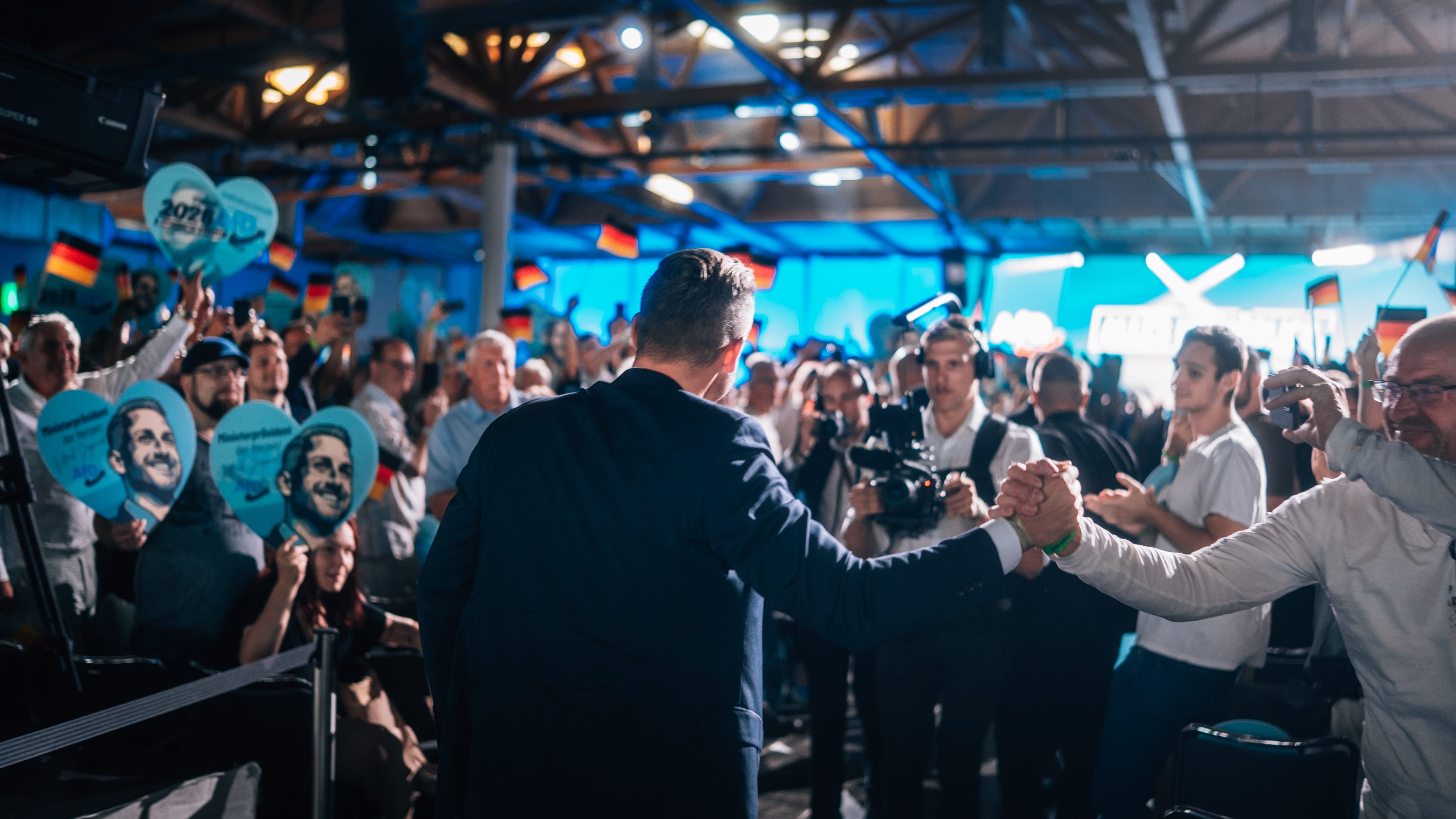
Geipel devotes a passage to Simon Kaupert, whom she describes as the Königsmacher, the kingmaker of the coming breakthrough, responsible for providing its Bildsprache—its visual language. What follows is a description of that visual world. Crowds dispersing through forests. Beers held by the lakeside. Blonde braids, blue scarves. It is written to indict. To mark out a target. To suggest that this beauty and this popular vitality are dangerous, that they conceal something, that they are sustained only by artifice. It is also the only moment in the entire essay when we are allowed to see what this country actually looks like—through Filmkunstkollektiv’s camera.
As for the rest, twelve minutes’ worth of text is devoted to 1.8 million voters. How many of them are allowed to speak? One. A Syrian man who confronts Siegmund during MDR’s Wahlarena.
A Constant Cannot Explain a Change
Now consider what is missing. June 2021. Same state. Same history. The same Baseballschlägerjahre, the “baseball-bat years.” The AfD wins 20.8 per cent—down 3.4 points. It is the first time the party has lost votes in a state election in eastern Germany. Reiner Haseloff’s CDU, meanwhile, wins 37.1 per cent and takes forty of the forty-one constituencies.
Ines Geipel’s entire genealogy was already in place in 2021. The neo-Nazi scene of the late GDR, Hoyerswerda, the pogroms, the Deutsche Alternative. Every link in her causal chain already existed, unchanged. And the AfD was losing ground. A constant cannot explain a change. If this long history explains the 42 per cent of 2026, what did it explain in 2021?
What has changed, by contrast, has been measured and published. Infratest dimap, July 2026. Before the 2021 election, 40 per cent of voters considered the CDU the party best equipped to solve the state’s problems. Today, that figure is 16 per cent. For the AfD, it has risen from 9 to 36 per cent. The same collapse is visible in assessments of the government’s record. The outgoing coalition had the confidence of 54 per cent of voters in 2021. The current coalition has the confidence of 33 per cent. Six in ten are unconvinced.
That is the mechanism. A governing party loses twenty-four points in perceived competence. An opposition party gains twenty-seven. This is retrospective judgment. Add to this the fact that Haseloff stepped aside and Sven Schulze became Minister-President in January 2026. Voters are facing an incumbent whom they never put in that office. These figures come from the polling institute whose results DER SPIEGEL itself publishes, in chart form, in the very same article. None of the three pieces mentions them.
The Thermometer
Return to our mechanism. These three figures—1,270, 4,000, 5,100—are not ours. They are the figures Ines Geipel lines up in her essay in support of her argument. She places them one after another, then writes that Saxony-Anhalt’s open radicalisation and the rise of the AfD have formed a pair from the very beginning. The reader thinks they are witnessing a transformation. What they are actually witnessing is a classification exercise.
The report from which these figures are drawn, presented on June 2, 2026 by the state’s Interior Ministry, makes this perfectly clear. In 2025, 3,680 people in Saxony-Anhalt belonged to political parties classified as right-wing extremist. The AfD’s state branch alone accounted for 3,500 members, up from 2,580 the previous year. Two-thirds of the radicalisation curve is the curve of membership in a political party. And the argument closes in on itself. The AfD’s growth feeds the extremism statistics. Those extremism statistics are then produced as evidence of radicalisation. Radicalisation is invoked to explain the AfD’s growth, and to warn voters about the danger they themselves supposedly represent. The thermometer measures its own temperature. Then everyone sounds the alarm about the fever.
What the State Says About Itself
Geipel cites the Sachsen-Anhalt-Monitor. She quotes only one paragraph from it. It is the tenth instalment of a longitudinal study, based on interviews with 1,101 people between May and July 2025, analysed by Katrin Reimer-Gordinskaya and Gert Pickel and commissioned by the State Chancellery under a CDU government.
This is hardly a suspect source. Ninety per cent of respondents say they are satisfied with their lives in Saxony-Anhalt. Attachment to their place of residence, their region, Germany and Europe stands, on almost every indicator, at its highest level since 2007. A society whose sense of belonging is at an eighteen-year high is not, at first glance, a society in the grip of the most violent extremism. But the study goes further.
Institutional trust is highly differentiated. The police, science and the courts score highly. The state government and the Landtag also perform comparatively well. The federal government, political parties and the Churches attract little support. This is not blanket distrust. It is discernment. These voters distinguish between institutions. They place their trust in what they see working close to home. They withhold it from Berlin and from political machinery. This is precisely how a state election becomes a national verdict. The data have been public since December 2025. None of the three pieces says so.
Two further findings complete the picture. Entrenched far-right worldviews remain below 10 per cent in the same study. Meanwhile, 52 per cent of respondents want a more restrictive asylum policy. Both figures coexist in the same survey. It is therefore arithmetically impossible to treat the majority demand as a symptom of extremism.
The authors note that the proportion of committed supporters of democracy has begun rising again compared with 2020 and 2023. Between 2023 and 2025, the AfD rises from roughly a quarter to more than 40 per cent of voting intentions. Over the same period, commitment to democracy strengthens. The correlation required by the radicalisation thesis does not exist.
Then there are the material facts, which nobody disputes. Since 1990, Saxony-Anhalt has lost nearly 700,000 inhabitants—a quarter of its population. No other German state has shrunk as much. Its population fell from 2.89 million in 1990 to 2.23 million in 2017. It now has Germany’s oldest population, and out-migration has been selective: young people left, and young women left first. That explains the male surplus among 18-to-29-year-olds that DER SPIEGEL observes in the convoy, without ever connecting it to anything other than a supposedly “far-right” atmosphere.
The proportion of the population with an immigrant background is around 10 per cent. This figure is usually turned against the voters themselves: it is below the federal average, therefore they must be voting against immigration they do not actually encounter. The argument is presented as decisive. It does not survive three seconds of scrutiny. Ten per cent is not a statistical abstraction. It is more than 200,000 people in a state with barely more than two million inhabitants. The equivalent of one of the state’s two major cities. One person in ten.
And an average always conceals a distribution. Those 200,000 people are not evenly spread across the villages of the Altmark. They live primarily in Halle and Magdeburg, where the proportion is considerably higher. People who live there do not vote on the basis of a federal statistic. They vote on what they see outside their windows.
I would add that, during an investigation with Paul Klemm of Compact TV, we were in working-class districts of Magdeburg. I remember that we were surrounded by Indians who assured us that the killer was Pakistani. I saw few Germans in these working-class neighbourhoods that had undergone large-scale demographic replacement, where foreigners occupied virtually all of the public space.
More importantly, it is not only the level that matters. It is the speed. The GDR had virtually no immigration. In a single generation, this state has gone from almost none to one person in ten—an extremely rapid shift for a place that had previously experienced very little immigration. That is what residents have witnessed: not a static condition, but radical change brought about by mass immigration.
Add to this the fact that a state election also passes judgment on national policy. Immigration is the leading stated reason for voting AfD, cited by 65 per cent of the party’s potential voters. They are not passing judgment only on the state’s policies. They are passing judgment on those of the country as a whole.
Ines Geipel explains this vote as a collective pathology: a society of suspicion, a collective of negative emotions, a German psyche damaged by violence. Within this framework, the voter does not judge. He suffers from a condition. But the voter is not ill. People vote on what they have in front of them: a promised factory that will never be built—Intel abandoned its roughly €30 billion Magdeburg project, for which the federal government had envisaged €9.9 billion in public subsidies—along with insecurity, a sense of dispossession, and so on.
Why This Goes Beyond Germany
That leaves the question for a French, English or Spanish reader: what does any of this have to do with them? Because these mechanisms travel, and because what we are dealing with here is not simply three articles but an apparatus. It has its institutions, its experts, its institutes, its prizes and its conferences. It has producers of statistics and producers of narratives, each citing the other. It feeds on what it denounces: the greater the threat becomes, the more necessary the apparatus becomes. It is a profession, and it is a market. Three mechanisms keep it functioning. The first manufactures the measurement. A state institution classifies an organisation, then counts its members. The resulting curve is used to demonstrate the danger represented by that organisation. The number is not false. It is manufactured by the question put to it.
The second manufactures the authoritative reference. A foundational article is published. Two years later, its conclusion is challenged in court. Nobody mentions it, because the narrative has acquired a life of its own and no longer needs its original source. Nobody rereads what they cite.
The third manufactures endorsement. A third party says what the newsroom does not wish to put its own name to, while the reader is not told where that third party is speaking from. The evidence appears to come from outside. It comes from within.
This apparatus claims to know everything about these voters. Their history, their wounds, their unconscious motivations. And when it fails to understand them, it does not ask whether it might have been wrong. It pathologises them. The voter becomes a symptom, the vote a relapse, the country a clinical case. It is convenient, because you do not argue with a patient; you treat them. The price is a society of fear. Fear is announced, measured, discussed—and then everyone acts surprised when it arrives. Names circulate. Faces are published. And a magazine cover identifies the most dangerous man in the country. A democracy does not die from too much debate. It dies on the day when the views of half the population cease to count as a political opinion and instead become a diagnosis. And that diagnosis has a target.
They were born in 1990 or in 2004. They live in towns the young women have left. They rode for hours beneath the sun behind a man on a blue Simson. They held their beers beside the lake. The women wore blonde braids and blue dresses. Some were about to vote for the first time in their lives. They were told they were ill. That they were a symptom. Their party-membership forms were counted as evidence against them. Their past was diagnosed, their braids described, their perfume analysed. On September 6, they will vote. Nobody will have spoken to them. Except Ulrich. And except those who film them. Because that is all Filmkunstkollektiv has done: show the real country as it presents itself. That is why three of Germany’s biggest newsrooms turned against a film crew. It is not their images they are being blamed for. It is that the images are sincere.
Credit photo : Filmkunstkollektiv
Matisse Royer
Voxeuropa Herald is an initiative that shares the voices shaping Europe today: elected officials, essayists, philosophers, activists, artists and influencers. These portraits are collective responses to the crises shaking our Europe. Faced with the major upheavals of our times, Voxeuropa Herald gives a voice to those who, throughout Europe, share solutions and visions for the future. The message is clear : European realities call for European responses.
🔹 Follow Voxeuropa on : X | Instagram | Telegram |
🔹 To support us - Paypal
🔹 Share, comment, and debate — ideas gain power when they circulate.