


In the European Parliament, a right-wing that is learning to think as one
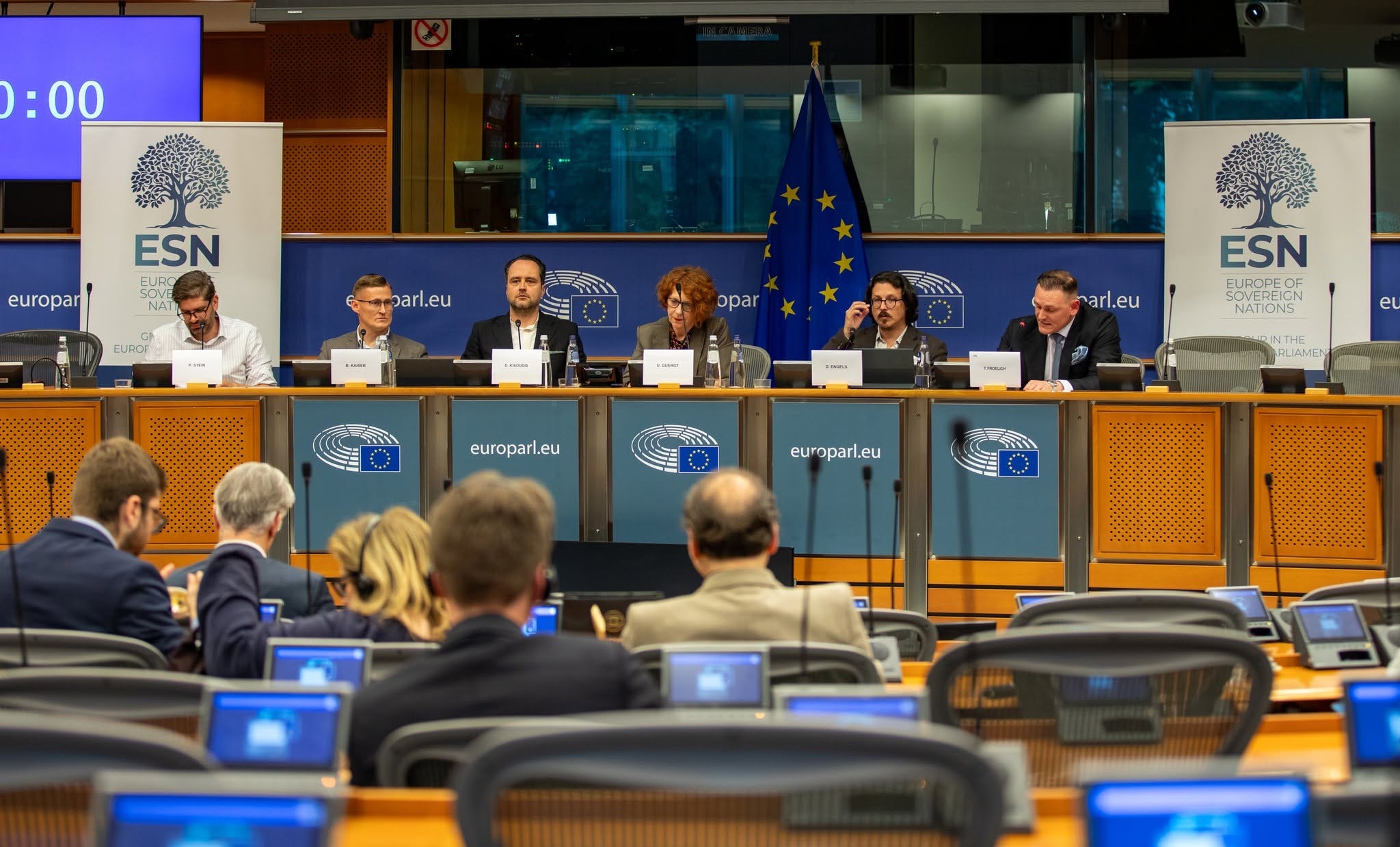
On 2 June 2026, thinkers and writers, activists, elected officials and journalists gathered at the European Parliament to debate the future of Europe. Not of the European Union as an institutional machine, but of Europe as a given reality: its past, its future, what it means to be European and the manner in which we can shape the destiny of our continent. The very title of the event — Europe: Yes, but how? — immediately betrayed the conviction underlying it: European power is not an option, but a necessity, in a world of growing conflicts and ever greater powers. At a time when the world order is fragmenting into rival poles, the question posed to our peoples is one of an urgency that can no longer be evaded.
The event was organised by Thomasz Froelich, a German MEP for the Europe of Sovereign Nations (ESN) group. Of Polish descent, Froelich carries within him the living memory of a century of confrontations between the Germanic and Slavic worlds — by arms or by words. It is precisely this dual belonging that led him to build bridges rather than trenches, and to place his singular position at the service of Europe. We met Froelich on the margins of the conference. His answer to the question of the European right’s principal obstacle is unambiguous: anachronistic national chauvinism. “When I observe the discussions between the German right and the Polish right, I think: oh my God, what are we talking about?” The man of dual anchorage — Polish by birth, German by mandate — has no patience left for parochial quarrels between movements that share the same enemies: woke ideology, the migration crisis, green deindustrialisation.
His response to this impasse is openly Gramscian. “If we want to change something, we need to gain cultural hegemony. Sometimes it is very important to read left-wing thinkers — Gramsci, for example. He understood that if you want to change the mindset of the people, the policy, the power, you need to gain cultural hegemony.”

The ESN, the smallest group in the European Parliament, lays claim to this inheritance: a space of intellectual freedom where other groups impose their lines. Froelich is convinced that this conference — academics, publishers, elected officials under one roof — sketches the coalition Europe needs to rebuild itself.
The five speakers, drawn from radically different backgrounds, brought equally divergent visions of the continent’s future. Let us begin with what one might call the Jungeuropa-crew: Philip Stein and Benedikt Kaiser. Stein has led the eponymous publishing house for ten years, never retreating from controversy — from publishing Pierre Drieu la Rochelle to citing Oswald Mosley from the podium. He has played a decisive role in disseminating European ideas across the German-speaking world.
Present at the European Parliament with a publishing house the Frankfurt Book Fair would rather see banned, Stein sees his invitation to the European Parliament as a “first move” in the battle of ideas: Jungeuropa at the heart of the institution, at a moment when the populist right is finally understanding that national withdrawal is a dead end.
His diagnosis of the European right’s deficiencies is unsparing: it suffers from two simultaneous shortcomings, in texts and in channels, but the first runs deeper. “The European right is currently too focused on social media and too little on producing content.” What he is calling for goes beyond remigration — a legitimate subject, but an insufficient one. “We need something like a European manifesto on which all Europeans can somehow agree.” His reference point? Dominique Venner, “the greatest European integrative figure,” whose texts “breathe the European spirit.” His appeal to young activists is direct: travel, translate, invest in mutual knowledge. “We are still too national in our thinking.”

Moderating the panel, Stein left it to Kaiser to carry the argument in the exchanges. Kaiser, a reference figure on the right on Gramsci, economic solidarism and the New Right, develops a layered conception of Europe: region — nation — Europe. This identitarian approach, rigorous in its construction, has profoundly marked a generation of nationalists.
Kaiser posed the question that frames everything else: does the reconstruction of Europe belong to metapolitics or to Realpolitik? His answer: both, in necessary interaction. The Vorfeld — that pre-political space of idea formation, narrative building, the construction of shared meaning — cannot substitute for parliamentary action, but without it, Realpolitik runs empty, without impulse, without horizon.
What Kaiser reads as a turning point is precisely what the evening illustrated: the European right is moving from “against” to “for.” “For decades, right-wing populism has only been against things: against the EU, against this and that, but not there fighting for something. And I think that is what we’re now experiencing: that this is now turning around.” The conference organised by Froelich is, in his view, “a small answer” — intellectual honesty demands he adds that “much more needs to happen” — but a sign that the Vorfeld and the Parliament can finally speak the same language.

Beside him sat Dimitrios Kisoudis, publicist and political advisor to AfD co-leader Tino Chrupalla. Kisoudis stressed the growing power of the American state, arguing that only a strong Europe could resist this all-devouring Goliath. Immediately to his left, Prof. Dr. Ulrike Guerot stood as something of an exception within the panel. Taking the floor at length — and clashing repeatedly with the other speakers — she defended a deeply cultural Europe: a position that, in the eyes of some of her opponents, does not go far enough.
Guerot is the productive dissonance of this evening. A professor dismissed from the University of Bonn in 2025 — she has filed a complaint before the Federal Constitutional Court, and stands ready to take her case to the European Court of Human Rights — she embodies, better than anyone else in the room, the narrowing of the space for debate in Germany. “Freedoms have disappeared in Europe that you took for granted ten years ago.” What she describes is not simply censorship: it is a civilisation of disagreement collapsing, replaced by an era in which the opposing argument has already become an offence.
Her vision of Europe is cultural before it is institutional. The continent’s original sin? The neoliberal order of the past four decades, which destroyed the living structures of modernity — aestheticism, beauty, the fabric of towns and villages, the Res publica (the common thing). Her compass: four words that European culture has carried since antiquity — res publica, la cità (the city), the citizen, dignity — words that find no equivalent in American culture. “The moment we realise that we have a jewel of European culture that unites us from Barcelona to Lodz, we could find something like serenity — or emancipation.”

Finally, Prof. Dr. David Engels chose a middle path, more measured than Kaiser, yet more firm than Guerot. A specialist in antiquity, Engels draws on his knowledge of the past to illuminate a possible future: that of a Christian Europe united in its faith.
The debates, at times heated, were only one dimension of the evening. The encounters, the reunions among old comrades, the new friendships forged and, of course, a few shared drinks rounded off a dense and intellectually serious evening — one worthy of the stakes that we, as Europeans, can no longer afford to ignore.
By Ward Van Meensel
Voxeuropa Herald is an initiative that shares the voices shaping Europe today: elected officials, essayists, philosophers, activists, artists and influencers. These portraits are collective responses to the crises shaking our Europe. Faced with the major upheavals of our times, Voxeuropa Herald gives a voice to those who, throughout Europe, share solutions and visions for the future. The message is clear : European realities call for European responses.
🔹 Follow Voxeuropa on : X | Instagram | Telegram |
🔹 To support us - Paypal
🔹 Share, comment, and debate — ideas gain power when they circulate.